Saturday, August 06, 2022

Two Mags

PAYING £6.99 for a magazine strikes me as a lot, especially when compared with most paperback history books.
But issue 38 of Ancient History proved too much of a temptation with its theme of Finding & Founding A New Home - Colonization In Antiquity.
Meanwhile issue 340 of Slingshot arrived in the post, but I fear I still cannot get used to the reduction in content caused by the use of a much bigger typeface.
Two mags

Friday, August 05, 2022

Angling For England

FOR my trip to Transylvania I was going to take just two books: Tim Parks' The Hero's Way - Walking With Garibaldi From Rome To Ravenna, and Philip Sabin's Lost Battles - Reconstructing The Great Clashes Of The Ancient World.
But I popped into Foyles in London's Charing Cross Road shortly before the trip began and bought a signed copy of Marc Morris's The Anglo-Saxons - A History Of The Beginnings Of England.
I am glad I did because even so I ran out of reading material before my nine-day visit was over.
But I am especially pleased I bought Morris's book as it is a riveting read, the only sore point being it ends at the Battle of Stamford Bridge in early 1066.
The Anglo-Saxons - not quite a "masterpiece"
Whether he ran out of space or time to finish the book, or whether a part two is planned, I cannot say, but otherwise it was for me £10.99 well spent.

Sunday, July 31, 2022

Castle Dracula

DURING yesterday's free day in the chess tournament I caught a bus to Bran to visit Dracula's castle.
That, at any rate, is how Bran Castle is billed, although it is doubtful if author Bram Stoker even knew it existed.
Not only that but Vlad the Impaler, aka Vlad Dracula, and serial killer Elizabeth Báthory, two of the real-life characters said to have inspired Stoker, almost certainly never set foot in Bran Castle.
Still, it was a fun half-day out, and Bran Castle turned out to have an interesting history of its own.
Originally built in wood in 1212 by the Teutonic Knights, it was destroyed by Mongols in 1242.
Permission for a stone castle was granted by Louis the Great, King of Hungary, Croatia and Poland, in 1377 to Germans, known as Transylvanian Saxons, who lived in what was then Kronstadt but is now Brașov.
The castle was used as a defence against the Ottoman Turks and became a customs point, with the village of Bran - now town-size - growing up in its shadow.


Tuesday, July 26, 2022

Roaming

AM visiting Transylvania, staying in the alpine resort of Poiana Brașov, which has a wooden church built in the Maramureș style.
This became popular in Austro-Hungarian lands from the 1500s onwards after the Catholic Habsburgs banned the use of stone in building new Orthodox churches.
Maramureș churches emphasise height
Modest from the outside, such churches tend to be anything but on the inside, and Poiana Brașov's example is no exception.
Small but beautiful
I am playing in a chess tournament, but have had plenty of time to catch up on my reading, including finishing Tim Parks' The Hero's Way - Walking With Garibaldi From Rome To Ravenna, and - for at least the second time - Philip Sabin's Lost Battles - Reconstructing The Great Clashes Of The Ancient World.
Pair of beauties
I nearly chucked the former in a bin after reading Parks' claim on page five that Pope Gregory XVI banned railways from the Papal States because he believed they were invented by the Devil.
Of course no educated man would have thought that - nor many uneducated ones for that matter.
In fact Gregory was anti-railways for similar reasons to the Duke of Wellington - both thought they would upset the social order by increasing the power of the lower classes, eg by increasing mobility, which would lead to higher wages, and by increasing commerce, which again would lead to increased self-sufficiency by those used to depending on their 'betters'.
I am very glad I persevered as the book turned into a riveting mix of travelogue and history as Parks and his wife retrace the route Giuseppe Garibaldi and his republican volunteers took in 1849 while evading multiple foreign and monarchical armies.
Sabin's book probably needs no introduction for dedicated wargamers. Suffice it to say that while I do not agree with all his assertions, especially with regard to how often the losing side in ancient battles had by far the most troops, I do find his book fascinating.
His rules for refighting such battles are very interesting, to say the least, and give the impression of probably being easier to play than they seem at first sight (I certainly hope so, anyway, because I do not find it easy to get my head around all the mechanisms).
But the bottom line with Sabin is he knows how to write, and that is half the battle - pun inadvertent, but left in-  with a book like this.

Friday, July 08, 2022

Newcastle (no, not that one)

AM visiting Bridgend, which is halfway between Cardiff and Swansea in South Wales.
The town was formerly dominated by the Newcastle, built in 1106 by the Normans as part of their slow conquest of Wales.
Newcastle gateway
The castle is very much in ruins, and so has the advantage of not being considered good enough to charge an entrance fee.
Looking back at the gateway from inside the castle
It would be easy to visit Bridgend and not know of the castle's existence, but there are signposts pointing you across Ogmore River.
Looking through the gateway to St Illtyd's Church
Little is known about the saint to whom the nearby Anglican church is dedicated, but he may have been a soldier who founded, or at least helped develop, a monastery and college in nearby Llantwit Major.
However the church was only named after Illtyd, also spelt Illtud, in the 16th century, having originally been dedicated to St Leonard, a Frank whose cult became popular in the 12th century.

Friday, July 01, 2022

Old Capital

AM visiting Kraków, which was the capital of Poland from 1038 to 1596.
The city's old town is well-preserved, and in 1978 was among the first sites given world heritage status by the United Nations cultural organisation Unesco.
St Mary's Basilica

Church of St John the Baptist and St John the Evengelist

Side street

Wawel Royal Castle

Barbican, built in the late 1400s to cover the main entrance to the old town

St Florian's Gate, built to protect the old town following Tatar destruction in 1241

Saints Peter & Paul Church, built 1597-1619

Bronze statue of the Wawel dragon, which legend has it terrorised the town until killed by a sulphur-filled dead cow left as bait by the sons of King Krak

Thursday, June 30, 2022

Between Two Rivers

AMONG the more-interesting books I have read recently is Paul Kriwaczek's Babylon.
Despite the title - perhaps imposed by the publisher, Atlantic Books - it covers a much longer period of history, starting well before Babylon was founded in about 2300BC.
The book's sub-title, Mesopotamia And The Birth Of Civilization, gives a much better idea of the contents.
As the blurb on the back states: "Kriwaczek tells the story of ancient Mesopotamia from the earliest settlements around 5400BC to the eclipse of Babylon by the Persians in the sixth century BC."
A faded photo - metaphor for Mesopotamia's glory?
To put the period in context, Kriwaczek points out in the introduction: "If history, as by most definitions, begins with writing, then the birth, rise and fall of ancient Mesopotamia occupies a full half of all history."
Inevitably, in covering such a huge span of time, the author resorts to sweeping generalisations that I imagine would make specialists wince - his observations on the Assyrian military, particularly the superiority of iron over bronze ("cheaper, harder, less brittle ... sharper ... keener"), certainly made me flinch, and I am no specialist.
But there is a lot of interesting reading in the book's c300 pages, and I feel much more informed for having read it.

Thursday, June 09, 2022

Chilled Argie-Bargie

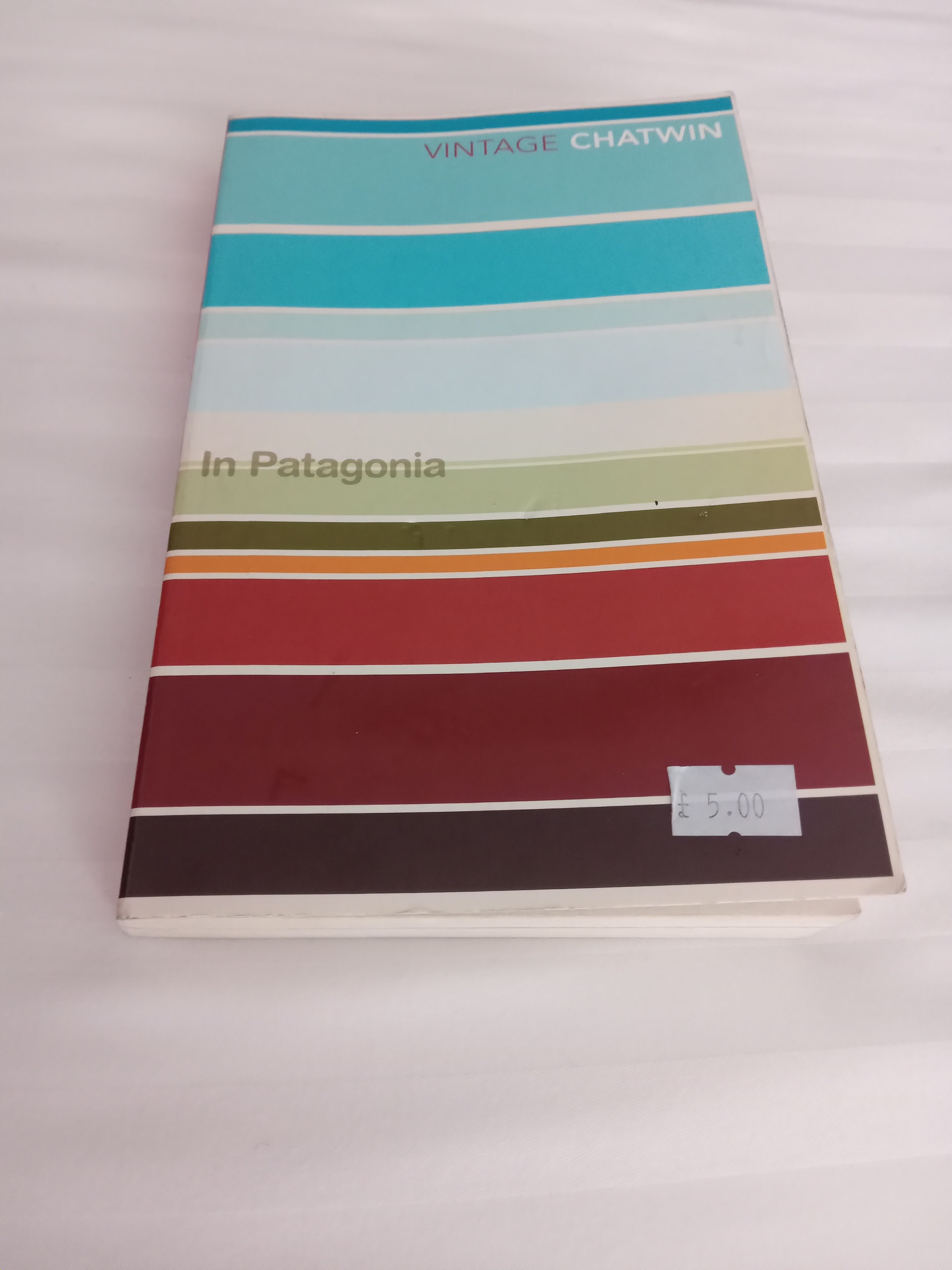
WHILE in Mallorca I have had the chance to finish Bruce Chatwin's In Patagonia, recently bought from a stall of remaindered books in Spitalfields market, East London.
"Vintage Chatwin," with the stall's £5 price tag still attached
The book, first published in 1977, won literary prizes, being hailed as a "little masterpiece of travel, history and adventure" and "one of the most strikingly original post-War English travel books."
Chatwin tells of the people he met and recounts incidents, many of them violent, from the history of Patagonia, which comprises the southern parts of Argentina and Chile, including the subpolar Tierra del Fuego.
Some of the tales are obviously fantasy, although Chatwin often repeats them as if he believes in the truth of what he is writing, or at least hopes readers will.
I cannot claim it is a book I could hardly put down, but the book is widely regarded as a landmark publication and I am glad I have read it.

Tuesday, June 07, 2022

Old Salts

AM visiting Mallorca, which is not just about beaches and bars.
At Colonia de Sant Jordi in the southeast are salt flats that may have been worked commercially more than 2,700 years ago for bartering with Phoenician traders.
The salt flats are still commercially exploited today


Tuesday, May 31, 2022

Marine Spears

HAVE completed painting a unit of Egyptian marines armed with spears.
The figures are 10mm from Magister Militum
Because most Egyptians lived close to the Nile, it was from the river that the kingdom was controlled.
This meant marines were the elite of the army until the appearance of chariots, and even then were held in high regard.
My marine spearmen have leather body armour and helmets, as well as shields, which allows them to be classified as having medium armour under Neil Thomas's rules.
Other Egyptian spearmen, and close-order archers, are classified as having light armour.
Marine spearmen with their marine-archer colleagues
The marine spearmen are equipped with short spears which could easily be called javelins.
The spears of regular spearmen (right) are much longer, presumably because marine spearmen could be called on to fight in confined spaces aboard ships and because short spears are easier to handle when assaulting from ship-to-land