Saturday, May 31, 2025

Border Town

TAKING advantage of the first really decent day of weather, I headed round the lake (called Lake Constance in English, after the town of Konstanz, but Bodensee in German, after the town of Bodman), across the border into Bavaria, and on to Lindau island.
Most of Lindau is now on the mainland, but the historic core is on the island, which in term housed a Roman settlement, a nunnery, a monastery, before becoming an Imperial Free City.
The island is in the distance, connected to the mainland by a causeway and a bridge
The walk should have been just over six miles, but it was more like seven, or more, as I hugged the shore and twice found the path fenced off without warning. This necessitated retracting my steps, which added to  the distance, but not the enjoyment.
Looking back to Bregenz, with what I am fairly sure are the Swiss Alps in the background
Most of the time I was walking either on a paved footpath beside a cycle lane, or on a narrow dirt track that weaved through trees.
Unusual mural on what turned out to be an art gallery
There were several possible stops on the way for refreshment, but I did not use them (it was a different story walking back in the full heat of the afternoon).
Closer view of Lindau island
This is Ascension weekend in Austria, which means Thursday was a public holiday (even supermarkets closed), and many people take Friday off as well to create a long weekend.
Even so the island was not overly busy, apart from the most popular cafes and restaurants.
Naturally there are plenty of buildings with murals
Some more elaborate than others
The entrance to the old harbour is flanked by Bavaria's only lighthouse and by a depiction of a lion from the Bavarian coat of arms
Close-up of the lighthouse
The lion viewed from the lighthouse
This 'fairytale castle' was built in the late-1300s for defence, but became the town prison

Friday, May 30, 2025

Bregenz War Memorials

The inscription across the top reads: in memory of the fallen of the upper town, and lists those "fallen" and those "missing" in 1914-1918 and 1939-1945

This plaque in the lower town roughly translates as: in honoured remembrance of our fallen comrades of the two world wars 1914-18 and 1939-45 Bregenz Volunteer Fire Department

Thursday, May 29, 2025

Wall Stories

BREGENZ has some interesting murals, known in Austria and Bavaria as Lüftlmalerei.
This depicts the Battle of Bregenz in January 1408 when an alliance led by Habsburg nobles defeated a besieging Swiss army that was probably not expecting to be attacked in winter

An image of George and the Dragon, apparently (first) painted almost 500 years ago, shortly after the town was bought by the Habsburgs

I am on less-sure ground here, but this series of  murals seems to be highlighting that the Han von Bleydegg and von Heerliberg families, prominent in Bregenz in the 1500s and 1600s, "praised Jesus Christ" while also taking up arms 

Another view

The figure on the far left is St Christopher with the Christ Child, and next to him may be St Gall, who lived in the area as a hermit after accompanying St Columbanus to Bregenz in 611 - presumably the kneeling figure represents the citizens of the town, some of whose coats of arms are depicted, praying for divine help

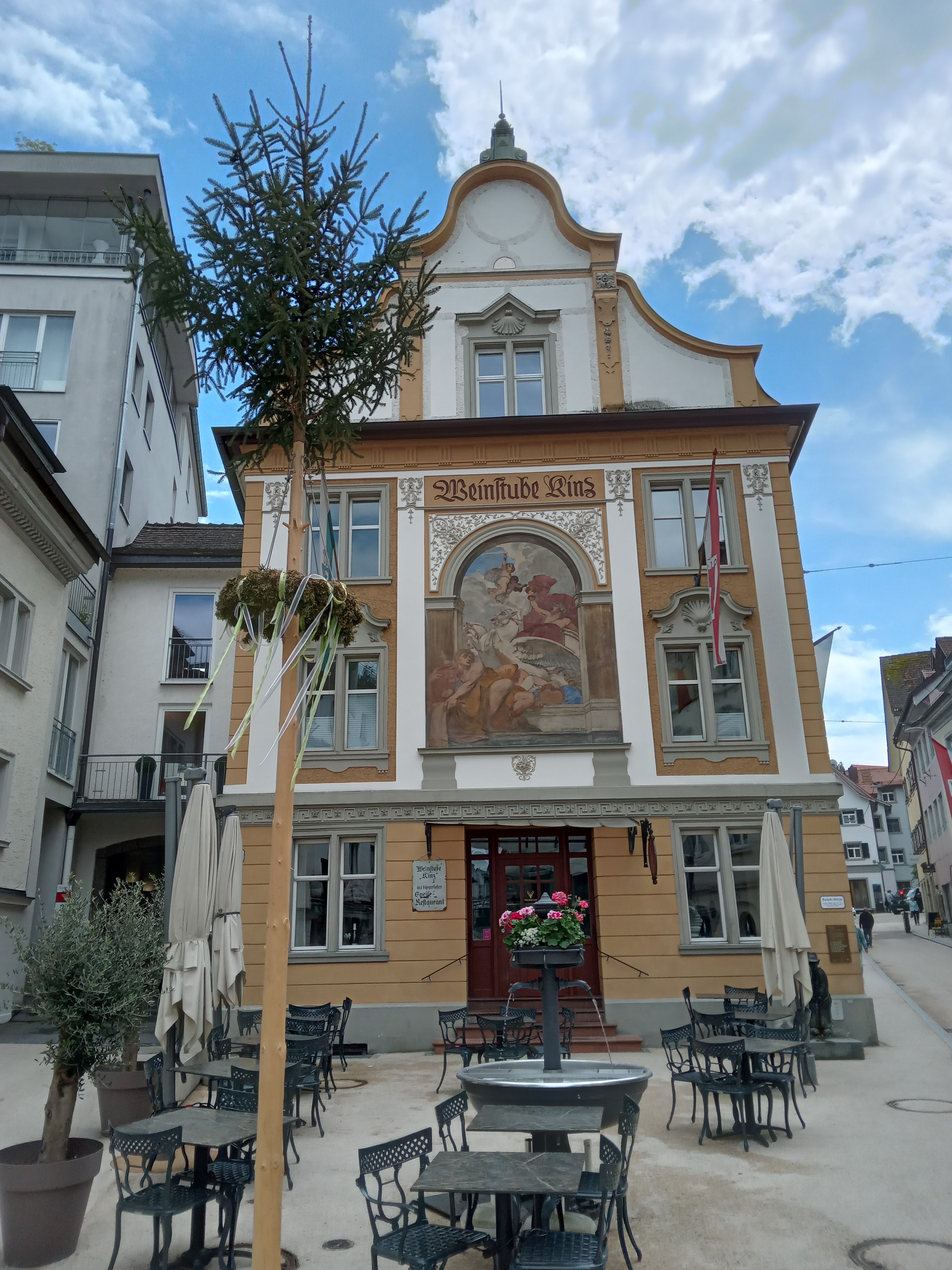
This mural on the Kinz wine bar in the lower town was painted in 1897 and depicts Apollo driving the chariot of the sun

I suspect this mural, promoting a repair workshop in the lower town, is also relatively modern

Wednesday, May 28, 2025

Bregenz Upper Town

THE main entrance to Bregenz upper town is through the old gateway, overlooking the modern town and lake.
It is also possible to skirt round to the rear, enjoying impressive views on the way
Path through old vineyards
Closing in on a side entrance
Sections of medieval walls are soon glimpsed 
Old and new
St Martin's Tower began in about 1250 as a warehouse, becoming the upper town's main lookout point around 1600

Tuesday, May 27, 2025

Upper Bregenz

THE Celtic town of Brigantion, as Bregenz was then known, was conquered by Rome in 15 BC, becoming the headquarters of the Roman fleet on the lake.
It was destroyed by the Alemanni in AD 260, later becoming home to the counts of Bregenz.
The old town, also known as the upper town, was founded in about 1170, gaining an impressive gateway made from local stone about 80 years later.
Approaching the gate from above
Close-up of the gate
The view after passing through

Monday, May 26, 2025

Lakeside

AM visiting Bregenz, an Austrian town on the shore of Lake Constance (Bodensee in German), sandwiched between Switzerland and Germany.
Bregenz was settled by the Celtic Brigantii 3,500 years ago, and today is regarded as the capital of west Austria, although having a population under 30,000.
Since 1946 it has hosted an annual music festival that includes opera performed on the world's largest 'floating' opera stage. 
This year's performance is of Der Freischütz (The Marksman).
The stage under construction

Saturday, May 24, 2025

Battersea Memorial Garden

KILLING time recently by wandering through the streets of Battersea, southwest London, I came across an attractive display of roses that turned out to be part of a memorial garden for locals who were killed in WW2.
The area was originally an "outdoors drawing-room," an idea I had never heard of, complementing next-door Christ Church.
Roses, with a shelter in the background

The shelter has a commemorative plaque

Friday, May 23, 2025

Top Read

I WAS, to say the least, effusive in my praise of E F Knight's Where Three Empires Meet, which I only bought after seeing it mentioned favourably in Peter Fleming's News From Tartary.
But having devoured it I was keen to read other works by him, including his first book, Albania: A Narrative Of Recent Travel.
It tells of barrister-turned-journalist Knight's travels through the mountainous Balkan country in 1878 - a journey that nearly led to him being killed as a spy.
Colourful cover - no illustrations inside, but plenty of vivid writing
While perhaps not quite matching the very high standards of his later work, Albania is nevertheless a great book.

Thursday, May 22, 2025

Travel Classic

ROBERT Byron's The Road To Oxiana has everything that I usually do not like.
It is described on the back cover as "poetic," which often is another way of saying flowery and overblown, it was written architecture of the areas he passed through at the forefront, and the author had questionable morals (but then don't most of us?).
Nevertheless it is hard to turn down the chance to read a travel book that has been so highly praised, and I am glad I bought it.
Oxiana is Byron's name for the region, better known, at least to me, as ancient Bactria, around what is now called the Amu Darya river but was earlier known as the Oxus.
He spent 10 months in 1933-4 traversing the area and further afield, with the names of the places he visited having great historic and romantic appeal, including Jerusalem, Damascus, Baghdad and Persepolis.
I can do no better than to quote from the reviews of other travel writers: "beyond criticism," "humour spans every genre," "most learned and most entertaining," "written with such charm and gaiety."
A classic, but I have to confess the striking photo on the Penguin paperback helped convince me to make the purchase - for once, at least, it was possible to judge a book by its cover