Thursday, January 12, 2023

Empire: Turn 16 (200-190 BC)

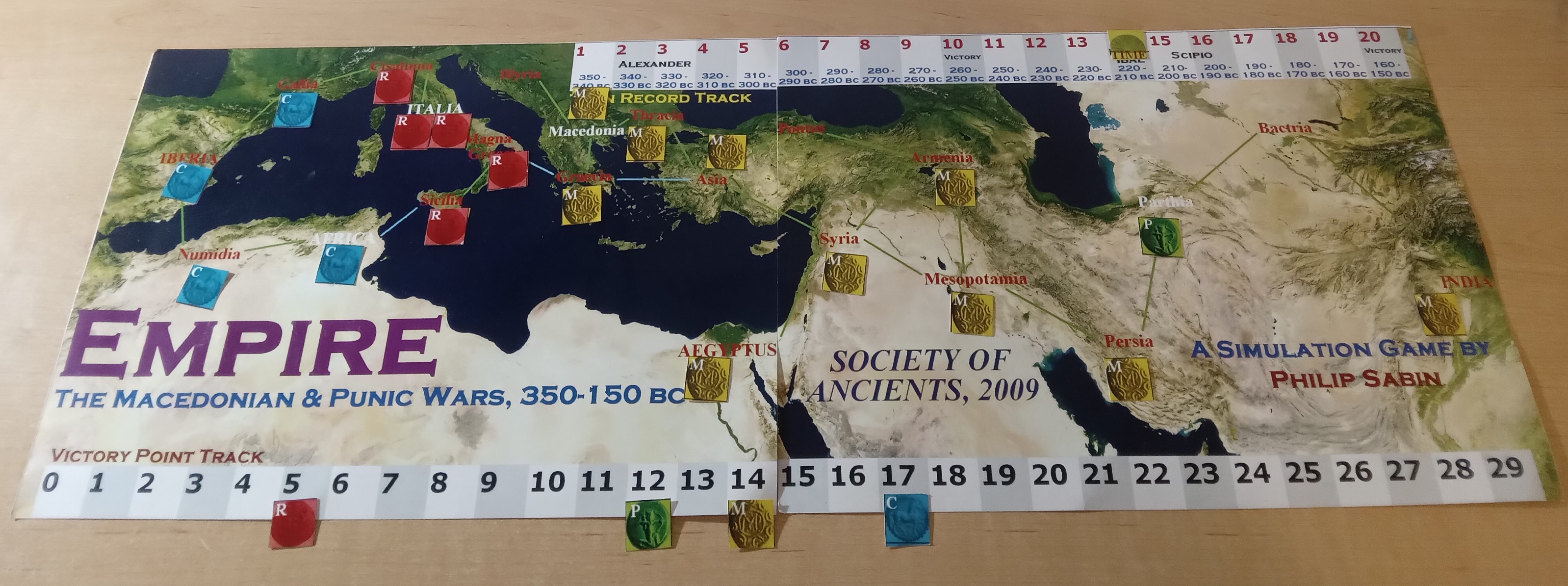
Situation in 200 BC
The Macedonians suffer a major blow as the province of INDIA revolts, and it is all but inconceivable that the Macedonians could reconquer it.
Scipio's second set of five campaigns starts with Magna Graecia, which is followed by a sea-crossing and conquest of Macedonian-held Graecia (just - the sea-crossing was not a problem, but a 2 was rolled for the land campaign, which was enough thanks to the great captain's +2 modifier and the fact that great captains do not suffer a -1 modifier for attacking a controlled province unless the province is a homeland). Next up is the Macedonian homeland, but that falls easily, as does Thracia. With the Macedonians badly weakened, Scipio finishes by again attacking Numidia, but this time the naval invasion fails.
The Macedonians, seeing the Romans as a bigger threat than the Parthians, attack Thracia, rolling a 5, which is enough to overcome the -1 modifier for attacking a controlled province.
The Parthians could attack INDIA, but that requires a 6 as they have a -2 modifier for attacking anywhere outside of their original empire (apart from AEGYPTUS). Instead they attack Mesopotamia, but fail.
Carthage easily crosses the sea to Sicilia, but the invasion is a flop on a throw of 1.
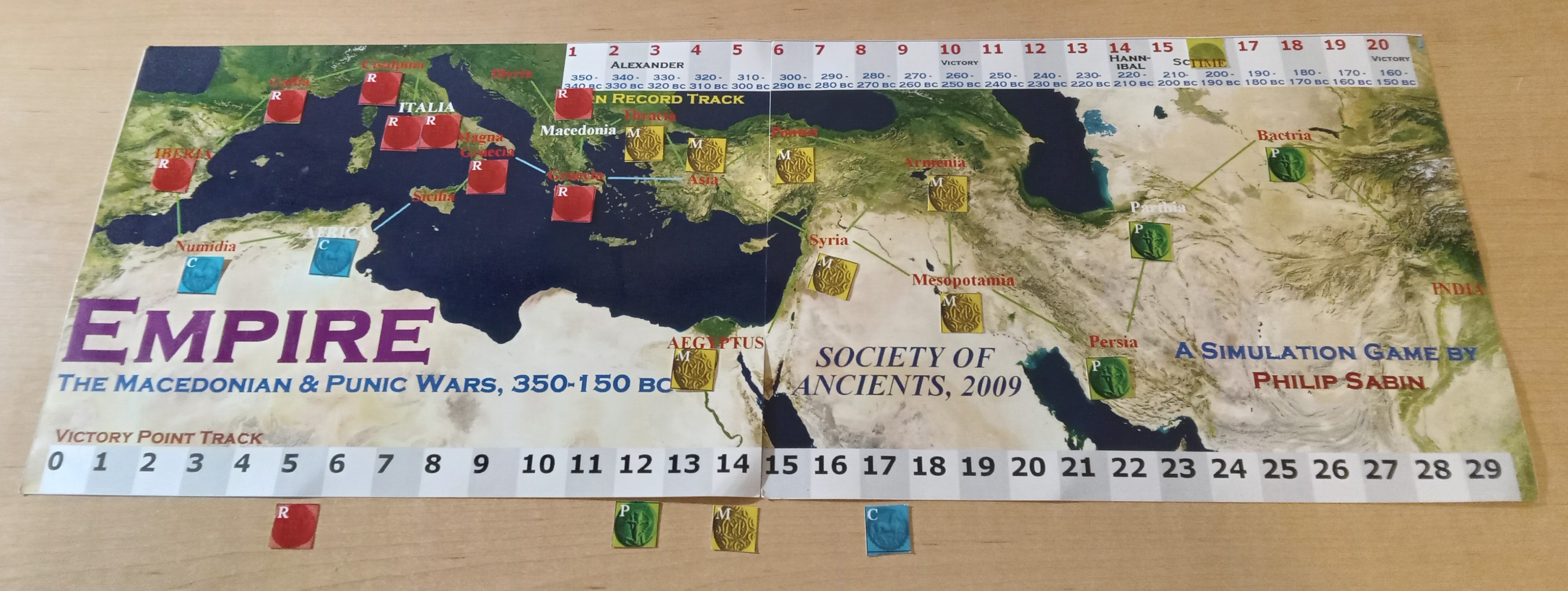
Scipio has helped Rome gain control of most of the north Mediterranean

Wednesday, January 11, 2023

Empire: Turn 15 (210-200 BC)

Situation in 210 BC
Mesopotamia again revolts from Macedonian rule.
This is the first of two turns in which Scipio the Younger is a great captain for Rome, but before he can expand Rome's boundaries he first has to spend a campaign consolidating Roman rule in ITALIA. This requires a 3 or better, rather than the normal 5, but the difference is academic as a 5 is thrown. Scipio then conquers Cisalpina, Gallia and IBERIA, successfully crosses the sea to Numidia, but throws a 1, the only result that fails to result in a conquest.
Carthage tries to take independent Sicilia, but the invasion force never arrives, presumably lost in a storm.
The Macedonians retake Mesopotamia.
With Parthia protected by the buffer province of Persia, the Parthians successfully invade Bactria.
Rome is on the rise, but it has a lot of catching up to do

Tuesday, January 10, 2023

Empire: Turn 14 (220-210 BC)

Situation in 220 BC
A blow for Carthage as Numidia revolts, just as Hannibal appears as the city's great captain. Historically Numidia was firmly under Carthaginian control when Hannibal appeared, but Carthaginian possessions further west did not spread north of IBERIA. In the game, Carthaginians do not have Numidia at the start of Hannibal's run, but have Gallia instead. This actually slightly favours Carthage as there is no -1 modifier for operating outside of the original empire when attacking Numidia.
The Carthaginians, with their five great-captain campaigns, go first, but disastrously roll a 1 when attacking Numidia, which is not enough despite Hannibal's +2 modifier. A second campaign succeeds, and Hannibal moves on to Cisalpina. Because he is a great captain, he ignores the usual -1 modifier for attacking a controlled province, but still suffers -1 for attacking outside of the original Carthaginian empire. With his +2 great-captain modifier, he therefore needs a 3, and that is exactly what is rolled. There are two Carthaginian campaigns left, and two possible targets: ITALIA and Sicilia. The former would see a +2 modifier for being a great captain, but -1 for being outside Carthage's original empire and -1 for attacking a controlled homeland. The chances are therefore even. Attacking Sicilia would require a sea-crossing, followed, if successful, by a campaign with +2 for a great captain but -1 for being outside Carthage's original empire. The chances are therefore 5-4 against. So attacking ITALIA has the slightly better chance of succeeding, and would have a major effect in that success would see Magna Graecia and Sicilia becoming independent and so easier for Carthage to conquer. Accordingly the Carthaginians use their fourth great-captain campaign to attack ITALIA, and succeed with a 6. For their final campaign they attack Sicilia, but the fleet is lost at sea (a 1 was rolled).
The Macedonians successfully invade Pontus.
Rome has to reconsolidate its control of ITALIA, but, requiring a 5 or 6, only rolls a 3.
The Parthians expand by conquering the province of Persia.
Carthage dominates the West, and Macedonians the East, but the Parthians are resurgent and Rome is about to get Scipio the Younger

Monday, January 09, 2023

Empire: Turn 13 (230-220 BC)

The calm before the storm as turn 14 will see the arrival of Hannibal, followed by Scipio the Younger on turns 15 & 16
Mesopotamia revolts from Macedonian rule, but it is reconquered immediately after the Macedonians are drawn to campaign first.
The Parthians attack Persia but only roll a 3.
Carthage attacks Gallia and throws the needed 6.
Rome counterattacks Gallia but rolls a 1.
The stage is set for Hannibal's entrance

Sunday, January 08, 2023

Empire: Turn 12 (240-230 BC)

Situation in 240 BC - the Persians/Parthians are back, and hostilities seem certain to resume between Carthage and Rome
The revolt dice again settle on independent Illyria, and so have no effect.
Rome attacks the Carthaginians in Gallia, rolling a 4, which is enough for success as the -1 modifier for attacking a controlled province is cancelled out by the Romans' turns 11-20 +1 modifier.
The Macedonians yet again attack Illyria, and yet again fail.
Carthage counterattacks Gallia, rolling a 5, but -1 modifiers for attacking outside of its original empire and for attacking a controlled province mean the invasion narrowly fails.
The Parthians attack Macedonian-controlled Persia, but only roll a 3.
Rome has conquered a province outside of Italy for the first time

Saturday, January 07, 2023

Empire: Turn 11 (250-240 BC)

Situation in 250 BC
It is hard to see the Persians/Parthians making a comeback, but do not rule out Rome. From this turn on the Romans receive a +1 modifier for every turn in which they do not have a great captain, and they have Scipio the Younger coming on Turns 15 & 16. During those two turns they will get five campaigns a turn and have a +2 great-captain modifier, and for the remaining turns they will get the +1 modifier explained above; and a further +1 modifier for it being within five turns of having Scipio. Nevertheless I guess the question is whether Rome can be quick enough in defeating Carthage before turning against the Macedonian Successors.
One of the problems of having a large empire, as the Macedonians do, is there are more places that can revolt, and this turn it is Bactria that becomes independent.
To make matters worse, the Parthians roll a 6, meaning they have resumed control of their homeland province of Parthia.
The Macedonians immediately attack Parthia, but only roll a 2.
With Gallia no longer wracked by tribal ferment, the Carthaginians invade and conquer the province with a roll of 6.
The Romans invade Cisalpina, rolling a 3, which is enough thanks to their turns 11-20 +1 modifier.
Rome and Carthage now confront each other across the Alps as well as the Strait of Sicily

Friday, January 06, 2023

Empire: Turn 10 (260-250 BC)

Crunch time - at the end of this turn the first victory points will be awarded (apart from the 12 Carthage and Persia each start with for past imperial glories)
Perhaps it is just as well Macedon failed to conquer Illyria last turn as the revolt dice show the province would have revolted this turn - a warning to the Macedonians about Illyrian fierceness?
The Macedonians ignore the warning and again invade Illyria, but are thrown back when they only roll a 3.
Carthage attacks Sicilia, easily crossing the sea, by rolling a 6, but the subsequent campaign roll of 5 is insufficient as the city is attacking outside of its original empire and is attacking a controlled province.
The Parthians fail to revolt in their homeland.
The Romans have three possible campaigns: against Cisalpina (-1 modifier because of tribal unrest on the first 10 turns); AFRICA (a sea-crossing followed by -1 for attacking a controlled province); Graecia (the same as AFRICA). It is a tricky choice because a successful attack on AFRICA would not make it fall, but would cause Carthage's other provinces to revolt (AFRICA only falls if there are no other Carthaginian provinces) and so greatly damage Carthage's victory points total (remember, IBERIA is worth double points). On the other hand Cisalpina is a slightly easier target (2-1 against succeeding, whereas the chances of a successful attack on AFRICA are 3-1 against, thanks to the complication of a sea-crossing). In the end I decide to try to emulate the consul Marcus Regulus who, in 256 BC during the First Punic War, along with his co-consul, Lucius Longus, defeated the Carthaginians in a naval battle off Sicily and followed by invading North Africa. A roll of 5 means the Romans successfully cross the sea, but a campaign roll of 1 sees them defeated in AFRICA, as Regulus was at the Battle of the Bagradas River.
Victory Points
Carthage scores five, made up of two each for controlling AFRICA and IBERIA, and one for Numidia. That puts the Carthaginians on 17 points at the halfway stage of the game.
The Romans score three for ITALIA and one each for Magna Graecia and Sicilia, taking them to five.
The Macedonians have 12 provinces, including AEGYPTUS and INDIA, scoring 14 points.
The Persians/Parthians have no provinces and so stay on 12.
Carthage leads at the halfway point, but will likely need great things from Hannibal on turn 14 if it is not to be overhauled by the Macedonians

Thursday, January 05, 2023

Empire: Turn Nine (270-260 BC)

Situation in 270 BC
Persian humiliation is complete as Pontus revolts, removing the last green counter from the map. If a comeback is ever achieved, the people will be known as Parthians, and I shall refer to them as such from now on.
Carthage attacks Magna Graecia, rolling a 5, but -1 modifiers for attacking outside of the original Carthaginian empire and for attacking a controlled province mean the campaign narrowly fails.
The Parthians fail to revolt in their homeland.
This is the first turn since turn two that the Macedonians have not received a modifier for either having a great captain, or for having had a great captain no more than five turns ago. Not that any such modifier would have been enough as, switching their attention to Illyria, they roll a 1.
Rome attacks Sicilia, rolling a 5, which is enough as a -1 modifier for attacking a controlled province does not halt the campaign.
For the first time Rome controls all of Italy south of Cisalpina

Wednesday, January 04, 2023

Empire: Turn Eight (280-270 BC)

Carthaginians are menacing Rome's ITALIA stronghold
With Carthage almost at the gates of Rome, this is a good time to explain some of the rules regarding ITALIA.
As has already been seen, Rome must first consolidate its rule in ITALIA, and when this is done it receives a second counter there.
If ITALIA is successfully attacked, instead of removing a counter, every other Roman-controlled province revolts.
If however, as in this game, Rome has no other provinces, then a counter is removed and Rome must consolidate again, requiring a campaign roll of 5 or better (3 if the campaign is led by Scipio the Younger).
Italia can only be attacked if it has two counters, so it can never fall to outside control, but clearly forcing the Romans to reconsolidate would set back their expansion plans.
Anyway, back to turn eight, and the revolt phase sees the province of Persia become independent (remember, this is not the Persian/Parthian homeland - that is Parthia).
The Macedonians campaign first and invade the newly revolted province. They roll a 3, which is just enough as there is a +1 modifier for peoples who no longer have a great captain but had one no more than five moves ago.
The Persians are up next, rolling a 5, narrowly failing to revolt in their Parthia homeland.
The Carthaginians have an interesting choice to make. They can attack ITALIA, hoping, as explained above, to slow Roman expansion. That would require a 6 as there would be -1 modifiers for attacking a controlled province and for attacking outside the original Carthaginian empire. Alternatively they could attack Gallia, which would also require a 6 as it is outside the original Carthaginian empire and has a -1 modifier for attack on the first 10 turns. So the chance of success in either campaign is 5-1 against. Slowing Rome is important, but conquering Gallia would gain an extra victory point, assuming it is still held when the points are first calculated in two turns' time. In the end I could not decide between the two options, and rolled a die with a 50:50 chance for the two campaigns. The choice fell on ITALIA, but that proved academic as the campaign roll was a 1.
The Romans make Carthage pay for its failure by conquering Magna Graecia with an emphatic roll of 6.
The Carthaginians have been thrown out of the Italian mainland, but still control Sicilia

Tuesday, January 03, 2023

Empire: Turn Seven (290-280 BC)

Situation in 290 BC
Magna Graecia again revolts from Rome - could it be overly harsh taxation, or perhaps a Greek-inspired love of freedom?
Carthage is quick to take advantage. Despite a -1 modifier for campaigning outside their original empire, the Carthaginians take Magna Graecia on a roll of 6.
The Macedonians again attack Pontus, but again roll a 1.
The Romans attack Magna Graecia, but roll a 3.
The Persians again fail to spark revolution in Parthia.
Carthaginian blue closes in on ITALIA