Showing posts with label Ancient History. Show all posts

Saturday, December 20, 2025

A History Of The World

A RACEY read, it is not, but Diodorus of Sicily's Bibliotheca makes up for that with quantity, covering the history of the known world - known, that is, to Ancient Greeks - from mythical times to shortly before the birth of Jesus.
It originally appeared in 40 'books', of which less than half survive, and was based on the work of earlier historians.
This is volume one - I have a second to go through
An introduction, probably written by historian Giles Laurén, who is listed as having edited the work, admits Diodorus's compilation method "made it almost impossible ... to write either a readable story or an accurate history."
That is somewhat off-putting, to say the least, but, with the proviso that everything needs to be checked before re-use, it nevertheless should make a good reference book.
It does not help that the history starts with ponderous retellings of myths, but the pace does pick up when Diodorus reaches the firmer ground of genuine historical events.

Wednesday, May 21, 2025

Effort-less

IT may not seem that way, but I have been keeping up with my reading - it is my reviewing that has fallen behind.
Accordingly I intend to catch up with some short reviews of recently read books.
First up is military historian Sotirios Drokalos's The Wars Between The Greeks & The Carthaginians.
The book is published by Pen & Sword, and comes with all the usual faults of that publisher, namely using spellcheckers instead of competent proofreaders, and more-or-less dispensing with any attempt at editing.
But the company has come up with a new - at least to me - faux pas in apparently dispensing with a translator and instead using an early version of Google Translate.
All these add up to a frustrating read, for example on page four:
Carthage established its presence first in the Balearic Islands and specifically in Ebusus (present-day Ibiza), which it has since been used as a Carthaginian base
On page 82:
An important role in those successes of Dionysius played his alliance with the Gauls
On page 95:
However, on reaching Carthage, he was severely blamed, and was driven to suicide, according to Carthaginian morals. Moreover, his fellow citizens were so enraged with him for the fact that, as they believed, he had missed an excellent opportunity to subdue Syracuse that after executing him, they also beheaded his corpse.
On page 126:
Nevertheless, Agathocles had to attack, as his supplies were running out, and his troops suffered from a lack of supplies.
Three defences are said to be "impregnable" and another "unassailable," we learn of the work of "gunsmiths," are told of an "oil tree" and meet Carthage's "Holy Company" (Sacred Band is meant).
Enough of the irritating negatives - what about the positives?
There are plenty, and not surprisingly as the west Mediterranean before the dominant rise of Rome has an exciting history.
If you have read the ancient sources, Drokalos is not really telling anything new, but he tells it in a fast-paced and gripping way that helped me easily speed through the book.
I would like to have seen fuller descriptions and discussions of the major battles (and especially a map or two), but there is only so much that can be included in this type of general study.
It makes a pleasing addition to my library, especially as I received a discount (I cannot recall how much) by pfre-ordering the £22 hardback.
Recommended ... with reservations

Friday, June 07, 2024

Living In A Mountain

IN east Sardinia is the distinctive mountain of Tiscali, whose name was chosen for the Italian telecoms and internet company Tiscali Italia.
The mountain, 518 metres (1700ft) above sea level, is a doline, ie most of the top of the mountain has collapsed, leaving a great depression and a partial roof.
Tiscali, in the central distance, looks like a regular mountain from afar
Its hollowed-out interior was inhabited from 1400-700 BC, and again from the 2nd century BC, possibly for another 1,200 years.
Some Nuragic people are thought to have lived there as a way of escaping Roman colonisers, who took the island from Carthage in 238 BC.
A hole in the wall makes a natural viewing point from which approaching legionaries could have been spotted
All is not as clear as it might be, however, as archaeologists reckon the building techniques used inside the mountain differ from Nuragic settlements elsewhere on the island.
Possibly the site was used in pre-Nuragic times, but whatever the circumstances it must have been a precarious place to live as apparently the only available water was from rain.
Nuragic dwellings are being painstakingly reconstructed, with much still to be done

Thursday, June 06, 2024

Nuragic Villages

THE Nuragic people were illiterate, but skilled at dry-stone building techniques.
Entrance to a Nuragic arena

Archaeologists believe seating on the internal sides of the walls of this building suggests it was a meeting place for elders

Wednesday, June 05, 2024

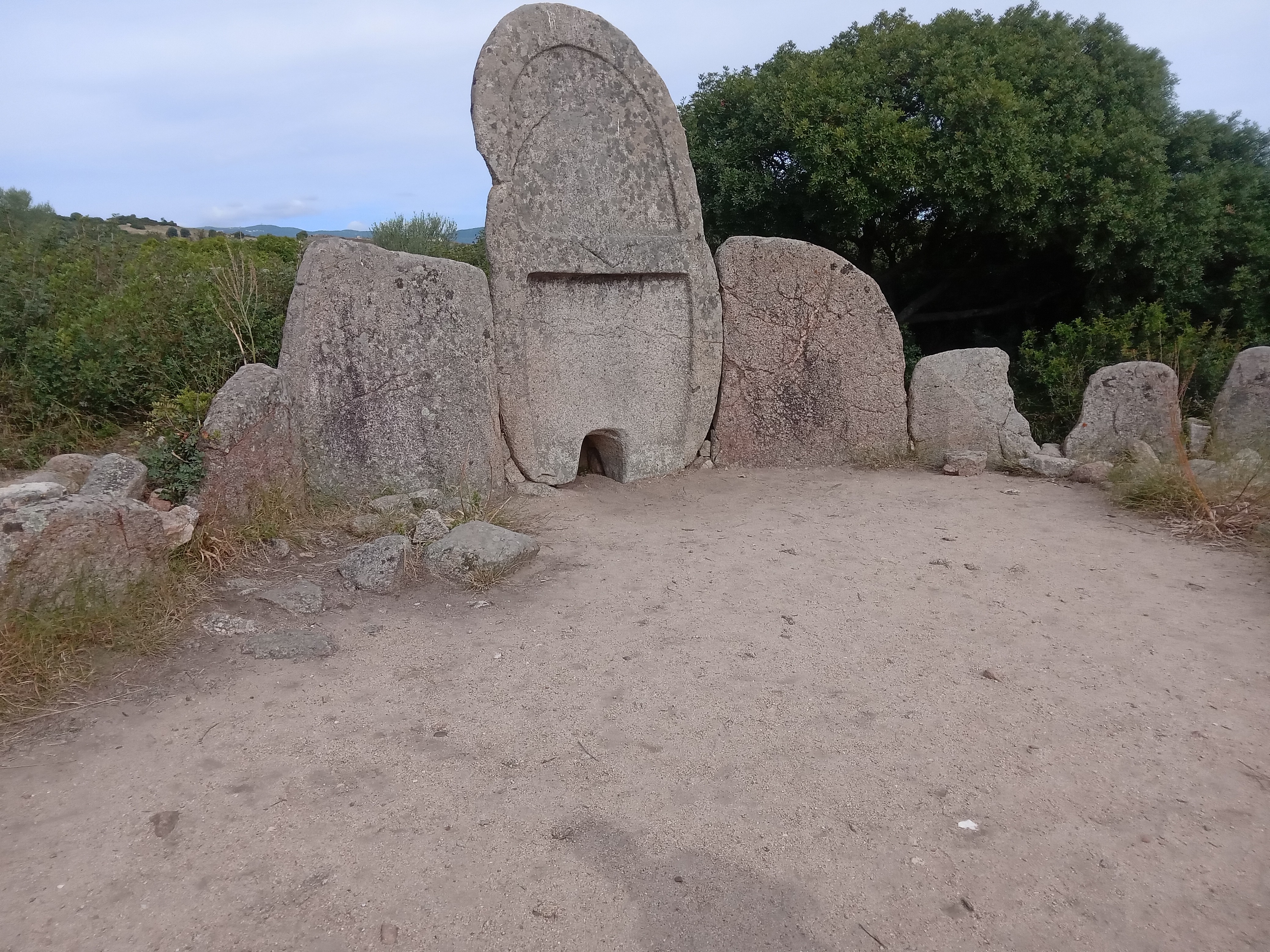
Giants' Tombs

Giants' Tombs are a distinctive Bronze Age feature of the Italian island of Sardinia.
Giants' Tomb near the town of Dorgali
The example pictured above, which I visited yesterday on a walking holiday, is one of about 800 on the island.
They were erected by the Nuragic civilisation, which flourished from at least 1700 BC - some sources say 2300 BC - and in parts of Sardinia may have outlasted Roman colonisation.
The Dorgali Giants' Tomb is a relatively sophisticated version in that the central stone or stele, made of granite and weighing more than seven tons, has been carved to give it a rounded top and central crossbar.
Behind the stele is a burial chamber measuring about 11 metres long.
The length of the burial chamber gave rise to the idea that these were graves for exceptionally tall people
In reality they were collective graves where locals were interred over generations.
Reconstruction by graphic artist Daniel Ventura

Monday, May 06, 2024

Past Glories

BROWSING WH Smith at Heathrow before catching a plane to Zurich, my eye was caught by a magazine-cum-pamphlet-cum book.
The fact it was published by New Scientist magazine almost put me off
I was right to be wary in that at times tedious wokeness breaks in.

Art, whether it is painting, a sculpture or music, is something we tend to associate with "advanced civilisations" (whatever that means).

But thankfully such examples are few, and for the most part the 100 pages are packed with fascinating history, or often pre-history.
Many of the articles read a bit like The Economist - visual soundbites that leave you wanting much more information.
But it was good to catch up with the current thinking on subjects such as the earliest cities, the development of writing and, believe it or not, the benefits of warfare.
Highly recommended, especially at the price of £10.99.

Tuesday, March 12, 2024

Big Hitters

ON a recent visit to Cambridge, I found the two books I had taken with me were not enough for a week-long trip (I had already got halfway through one of the books, and the other proved a huge disappointment).
Luckily I came across a secondhand bookshop that proved to have a decent history section, and from there I bought The Secret Of The Hittites: The Discovery Of An Ancient Empire for £3.50.
This is a 2001 paperback version of a book first published in German in 1955
Anyone with more than a passing interest in ancient history will almost certainly have heard of the Hittites, an Indo-European people who carved out an empire in much of what is now Turkey.
But 200 years ago they were very much a forgotten race, apart from a few mentions in the Bible where Hittites are listed with other tribes as occupying or impinging upon the Promised Land.
However, the fact individual Hittites are described in the Bible as serving King David might have alerted scholars to the people's possible importance.
It took a series of discoveries, still being made when this book was being written, to change that.
Normally a book of this sort, almost 70 years old, would be terribly dated.
But the author, Kurt Marek, a German using as a pen-name CW Ceram, does not try to give a definitive account of the Hittites.
Instead he describes how the world's state of knowledge of the Hittites had got to where it had reached by the mid-1950s.
It makes for an entertaining read, a kind of historical whodunnit?, and I certainly feel as though I enjoyed much more than my money's worth.

Sunday, February 18, 2024

Dutch Treat

MY latest reads include Tom Holland's Rubicon - The Triumph And The Tragedy Of The Roman Republic.
It tells the story of the rise of Rome and how it changed from a republic, albeit not a democratic one, to an empire.
The book is an entertaining read, but it is important to remember it is faction rather than fact.
Rubicon - crossing from fact into fiction
The author is continually relating how protagonists in the story were thinking, even  though most of the time he cannot possibly know what he confidently states as the truth.
There is also little or no discussion of sources, and there are the usual "impregnable" strongholds, so the book is definitely for the general reader.
Nevertheless I found it fun, and there is no arguing with the fact that it received many glowing reviews, although those quoted in the book are very much from populist publications, eg the Daily Mail, BBC History magazine and The Independent On Sunday.

Thursday, November 10, 2022

Tactical Mistake

LOOKING for something to read on a foreign trip, I popped into the Orcs (sic) Nest in central London and bought Strategy & Tactics Quarterly's Alexander The Great.
Alexander The Great - originally published last autumn
It cost about £14, which seemed reasonable for what I realised would be little more than a rehash of what I already knew, but that would include a game that might be fun to play.
I was sadly disappointed as all I got was the magazine - apparently editions with a game cost considerably more, which I guess I should have known.
Still, the magazine was an interesting read, although it could have done with a decent editing job, especially in resolving differences between what the text says and what some of the maps say.

Sunday, July 09, 2017

Slingshot

THE May/June issue of the Society of Ancients' magazine Slingshot arrived yesterday afternoon and, as usual, I have read it in less than 24 hours.
Definitely better late than never
That is not a result of there being few articles of interest, but rather due to most of the articles being exactly what I love to read.
Pride of place in my view goes to Richard Taylor's piece on the meaning of a single word from Plutarch. The article takes up more than five (unillustrated) pages, but is in no sense dry and kept me enthralled to the end.
Now it often happens that an article in Slingshot giving a new interpretation of ancient history meets with a thorough rebuttal in the very next issue, but, for the moment at least, I am convinced by Taylor's claim that "belosphendonai" refers to slung stones rather than "fiery bolts."