Showing posts with label Hebrews. Show all posts

Wednesday, April 29, 2026

Hebrews

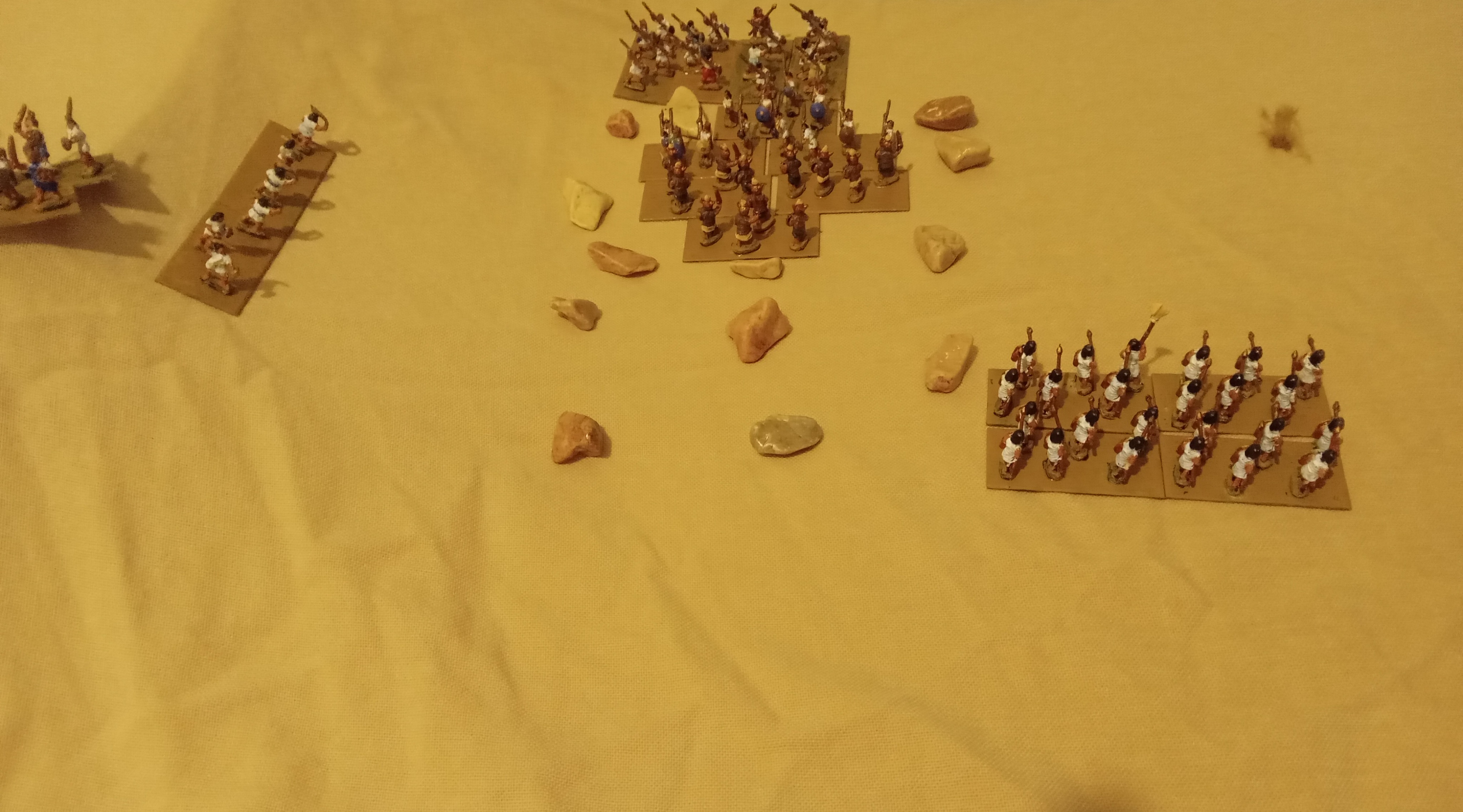
Left to right, front row: open-order javelins, three units of slingers, two more units of open-order javelins; middle row: six units of auxiliaries; rear row: five chariot squadrons
The 17 units allow me to field any Hebrew army for Neil Thomas's biblical rules in Ancient & Medieval Wargaming up to the end of the reign of David's son Solomon.
After him, Thomas recommends using the Canaanite & Philistine list for both the northern kingdom (Israel) and the southern kingdom (Judah).
The troops' lack of uniforms, and generally undistinguished clothing, means all the units could easily be fielded in many other Middle Eastern forces without looking out of place.

Wednesday, March 25, 2026

Biblical Update - Hebrews

NEIL Thomas's list for a Hebrew army in Ancient & Medieval Wargaming is really three lists, covering the same centuries as the Early Hebrew and Later Hebrew lists in De Bellis Antiquitatis.
(Thomas uses the word Israelite, rather than Hebrew, but this can lead to confusion after the Jewish kingdom splits into a northern part, Israel, and a southern one, Judah).
The main list, which covers Hebrew armies up until the accession of David's son Solomon to the united throne, is as follows.

SIMEONITES & EPHRAIMITES Auxiliary infantry, light protection, elite 1-2 units
GADITES & ISSACHARITES* Open-order javelinmen, light protection, average 1-2 units
BENJAMINITES Open-order slingers, light protection, average 1-2 units
OTHER SEVEN TRIBES Auxiliary infantry, light protection, average 2-4 units
One of the units of Benjaminites can be equipped with bows, rather than slings.

The army enjoys a special Guerrilla Warfare rule, designed to reflect its skill at ambushing enemies after luring them into suitable terrain.
Accordingly the Hebrew commander can add two pieces of rocky terrain anywhere on the battlefield (size of the terrain pieces is not stated, but a diagram of suggested deployment for the army shows two units in each of the pieces of rocky ground).
The Hebrew commander can also deploy two open-order units anywhere on the battlefield after the enemy has finished setting up. Again, the mechanics of this are not explained.

The second list is specifically for Solomon's army, which cannot use the Guerrilla Warfare rule, but gets an additional troop category:

CHARIOTS bow-armed light chariots, elite 1-3 units

With this addition I think it only fair that the Simeonites and Ephraimites lose their elite status, becoming average.

The third list is for armies after Solomon, ie for the kingdoms of Israel and Judah, and ignores all the above.
Instead Thomas says to to use the list for Canaanite and Philistine armies, and I will look at this later. 
*"Issacher" in A&MW, but clearly Issacharites is meant.
Hebrew army at the Battle of Palm Hill
Left-to-right in the photo are Issacharite javelinmen; Benjaminite slingers and Ephraimite auxiliary infantry in rocky ground; two ordinary bands of auxiliary infantry in the centre rear; more Benjaminite slingers and Simeonite auxiliary infantry in the second patch of rocky ground; Gadite javelinmen.

Friday, June 06, 2025

Taking Stock II

My Hebrew forces
From left-to-right are two units of slingers, six units of auxiliaries, five squadrons of chariots and two units of javelinmen.
Under Neil Thomas's rules in Ancient & Medieval Wargaming, a pre-Solomon Israelite army consists of one-to-two units each of elite auxiliaries (Simeonites and/or Ephraimites), average javelinmen (Gaddites and/or Issacharites) and average slingers (Benjaminites).
In addition the army has two-to-four units of average auxiliaries (other seven tribes).
Solomon's army receives an extra choice in the shape of one-to-three squadrons of chariots.
Post-Solomonic Hebrew armies of both Israel and Judah are considered by Thomas to have "lost their cutting edge," and so use his Canaanite and Philistine list (armies that I have not recruited yet).

Friday, April 11, 2025

Summing Up The Battle Of Palm Hill

FOR a long time the battle seemed to hang in the balance.
Indeed my opponent remarked afterwards that he bitterly regretted sending his chariots forward early in the battle in such a cavalier manner.
Disaster nearly struck the Egyptians when their royal squadron, which had Pharoah with it, was reduced to one base.
If the squadron had been eliminated, every other Egyptian unit would have had to take a morale test, either immediately or at the start of the next turn, which could have led to serious losses.
But Pharoah pulled the royal squadron out of the front line, and kept the other squadrons away from the bulk of the Hebrew army, and so unlikely to suffer serious harm.
Meanwhile I played a waiting game, which may have been a mistake as the Egyptian units on their right flank gained a local superiority over my men.
Even so the Hebrew collapse, when it came, was quite shocking in its speed.
One thing we agreed on was that the rules, based on Neil Thomas's biblical section in Ancient & Medieval Wargaming, but with significant amendments and supplements, partly based on Bob Cordery's Portable Wargame ideas, worked well.
I propose to look at those changes to the core rules with a view as to which to keep, and whether further tinkering is advisable.

Thursday, April 10, 2025

Battle Of Palm Hill - Turn Nine

Situation after eight turns
Pharoah wins the dice-off (6-5, after a 4-4 draw) to see who goes first.
He immediately orders the Sherden to exit the battlefield. The unit is lost, but I have to remove two units of my own. This is because of a rule Neil Thomas uses to simulate the demoralising effect of an army having its camp and/or baggage pillaged. When an infantry unit, other than open-order light infantry, exits the battlefield on the enemy's side of the table, it is lost, but takes two enemy units with it.
I choose to give up my single-base Issacharites and the doomed auxiliary infantry beside the eastern rocky ground.
This reduces the Hebrew army to four units, and I will not be able to stop another Egyptian infantry unit exiting the northern edge of the battlefield, so I concede.

Wednesday, April 09, 2025

Battle Of Palm Hill - Turn Eight

Situation after seven turns - the Hebrews still hold Palm Hill, but the fighting around the eastern rocky ground is intensifying
Pharoah wins the dice-off (4-1) to see who goes first.
He starts by manoeuvring the right-flank chariots so they have a clear shot at my auxiliary infantry behind the eastern rocky ground. The bowmen score two hits, but I roll a pair of 6s as saving throws, meaning both hits are cancelled.
The Egyptian spearmen now charge my auxiliaries. Both sides roll one die per base, and I score three hits while the spearmen score two. None of the hits is saved. The three suffered by the Egyptians are resolved as the loss of a base and the forced fallback of 6cm. The unit's morale suffers, meaning another base is lost. My two hits are both resolved as forcing fallbacks, but since that would take the unit off the battlefield, two bases are lost instead. These losses represent a most unfortunate example, from my perspective, of bad generalship in that I should never have put my men in such peril.
The Egyptian right-flank archers are just out of range of my men on Palm Hill, so Pharoah advances his unit 8cm.
The Sherden in the rocky ground renew their melee against my Simeonites, scoring a tremendous three hits, while suffering none. However two of the hits are saved, although the final one results in my men losing a base, and their morale collapses, despite being elite troops, meaning their final base is also removed.
The marine archers in the centre of the battlefield shoot at my four-base Benjaminite slingers on Palm Hill, scoring a hit that causes my men to lose a base, and a further one is lost to poor morale.
Finally the left-flank chariots fall back slightly and shoot at the Issacharite javelinmen, scoring a hit, which causes my men to lose a base, and a further one to poor morale.
A catastrophic half-turn for the Hebrew cause
I start by charging the Egyptian spearmen with my auxiliary infantry beside the eastern rocky ground. My men are doomed anyway, but at least this way they might just take an enemy unit with them. Both sides score a hit. I save the hit my men suffer, but the Egyptians are forced back 3cm. I take the chance to follow up and continue the melee, but my men suffer two hits while inflicting none. However one hit is saved, and the other is resolved as falling back 3cm. Pharoah chooses to follow up, but this time the fighting is inconclusive.
My right-flank Benjaminite slingers shoot at the marine archers, but without effect.
The other band of Benjaminite slingers fires at the other unit of Egyptian archers, but also without effect.
The Issacharite javelinmen bravely, despite being reduced to a single base, advance and hurl their javelins at the chariots ahead of them, but I roll a miserable 1.
My ordinary auxiliaries on Palm Hill turn, costing them half their movement allowance, and start down towards the Sherden in the eastern rocky ground, covering 5cm thanks to the Move Variation rule.
Finally I at last activate the Ephraimites, sending them in support of the ordinary auxiliaries, and they also cover 5cm thanks to move variation.
The Hebrew cause is now a lost cause, but I am not conceding as I want to play another turn to illustrate an interesting rule in Neil Thomas's Ancient & Medieval Wargaming

Tuesday, April 08, 2025

Battle Of Palm Hill - Turn Seven

Situation at the end of turn six
I win the dice-off (4-2) to see who goes first.
My Issacharite javelinmen edge down the western slope of Palm Hill to hurl their javelins at the oncoming Egyptian chariots, scoring two hits (and very nearly three - I rolled 6, 5 and 4). Neither hit is saved, and, despite the charioteers being elite, a base is lost, the rest of the squadron falling back 3cm. However the charioteers pass the compulsory morale test.
Benjaminite slingers on top of Palm Hill, having reorganised, advance and shoot at at the Egyptian archers to their front, but ineffectively.
The other band of Benjaminite slingers line up to shoot at the other unit of Egyptian archers, but also fail to score a hit.
My auxiliaries behind the eastern rocky ground advance around it, but having to turn to face the approaching Egyptian spearmen uses up half their movement allowance.
Next I fight the continuing melee in the rocky ground, but only the Sherden score a hit. However, I roll a 6 saving-throw to negate it.
Finally I pull back slightly the three-base auxiliaries on top of Palm Hill, and once again leave the Ephraimites where they are.
Casualties can expect to start mounting as the armies close in
Pharoah starts with his left-flank chariots shooting at the Issacharites, scoring two hits. I save one, and the other is resolved as the unit falling back 3cm.
Next his right-flank archers shoot at the slingers ahead of them, also scoring two hits. Again I save one, and again the other hit is resolved as forcing the unit back 3cm.
The other archers shoot at the same target, scoring one hit, causing the slingers to fall back a further 3cm.
Next up is the melee in the eastern rocky ground. This time my Simeonites inflict two hits, while only suffering one. However, Pharoah's saving throws both come up 5, which is enough as the Sherden have medium armour. I also roll 5, but that is not enough for men with only light protection. However, my resolution roll of 3 causes the Simeonites to fall back 3cm, rather than lose a base, as they are elite. This forces them out of the rocky ground, and the Sherden follow up to initiate another round of hand-to-hand fighting. The result is again two hits to one in favour of the Simeonites. But again the Sherden's hits are saved, while mine is again resolved as forcing the unit back 3cm, taking the men to the edge of the battlefield. Naturally the Sherden again follow up, but this time inflict no hits, while suffering two themselves. Neither hit is saved, and the Sherden are forced back 6cm. I now choose to exercise my option to follow up, but the only hit is scored by the Sherden, and once again my men are forced back 3cm. The Sherden again follow up, and both sides inflict two hits. One of mine is saved, but the other results in the loss of a base, although the Simeonites' morale remains steady. One of the Sherden's is saved, and the other forces them back 3cm. Since my men lost a base, there is no possibility of them following up, and so the epic melee ends, at least for this half-turn.
The right-flank chariots advance and shoot at the auxiliaries who have just emerged from behind the eastern rocky ground, scoring a hit, but it is saved.
The Egyptian spearmen advance towards the same auxiliaries.
The fighting between Palm Hill and the palm grove is likely to prove pivotal for the battle

Monday, April 07, 2025

Battle Of Palm Hill - Turn Six

Situation after turn five, looking from behind the Egyptian lines towards Palm Hill
Pharoah wins the dice-off (3-2, after a 2-2 tie) to see who goes first.
He starts by ordering his right-flank chariots to advance and shoot at my Simeonites in the eastern rocky ground. However they drag their heels, or at least the horses drag their hooves, as the squadron only advances 16cm (Pharoah rolled a 1 under the Move Variation rule), leaving them out of mounted-bow range.
Next the Sherden enter the rocky ground and engage the Simeonites in hand-to-hand fighting. Since this is a battle in difficult terrain between two bands of auxiliary infantry, both get one die per base. My men fail to score a hit, but the Sherden are slightly more successful. However the one hit they register, while not saved, is resolved as my unit falling back 3cm, rather than losing a base. Pharoah exercises his right to follow up, and so another round of meleeing takes place, still in the rocky ground. This time both units inflict two hits, and none is saved. One of the hits my men suffer results in the loss of a base, but the other only causes them to fall back a further 3cm (I rolled a 3, which is enough to avoid the loss of a base when the unit is elite). The Sherden suffer similarly - a base lost, and falling back 3cm. Both units pass their compulsory morale tests.
The Egyptian close-order archers in the centre of the battlefield shoot at my slingers in the rocky ground on Palm Hill, scoring one hit. This is halved because units in such terrain effectively count as being in cover, but on a 50:50 roll the half becomes a full hit. My saving throw fails, but the hit is resolved as forcing my men back 3cm. Since they cannot fall back through the Ephraimites, they have to retreat to the latter's right, between the auxiliary infantry and the Issacharite javelinmen. Since the gap is too small for the unit to fit through in good order, my opponent and I agree that, even though the slingers are in open order, they would become a disorganised and confused mess, requiring a turn to reorganise (we felt this was the fairest interpretation). 
The other unit of Egyptian close-order archers advance, but only 6cm instead of its full allowance of 8cm, thanks again to the move-variation rule. However both units of spearmen advance the full 8cm.
Finally the left-flank chariots advance 24cm and shoot at the Issacharite javelinmen on Palm Hill, but unsuccessfully (Pharoah rolled two 3s, 2 and 1).
The Egyptian attack continues, but in a somewhat uncoordinated manner
Close-up of the confusion among Benjaminite slingers atop Palm Hil
I start by ordering the Issacharites to advance and hurl their javelins at the approaching chariots. They score a hit, which is not saved, but is resolved as the chariots being forced back 3cm.
The Benjaminite slingers on Palm Hill reorganise, but cannot move this turn.
The auxiliary infantry next to the rocky ground on the hill charge the approaching marine spearmen. The latter are not quite caught in the flank, but the Hebrews are uphill of their opponents, and so receive an extra die per base in the first round of the melee. The eight dice produce four hits, but the marines, despite only having two bases, fight back with two hits. One of the four hits is saved, but two of the other three are resolved as the loss of a base, meaning the marine spear unit is eliminated. However, they manage to eliminate a base of the auxiliaries, and cause the remainder to pause and fall back 3cm, but morale holds good.
The two-base Benjaminite slingers, recently expelled from the eastern rocky ground, manoeuvre along the hill (movement on hills is not normally penalised), and shoot at the Sherden, but without success.
The Simeonites charge the Sherden for another round of hand-to-hand fighting, both units scoring a hit. However the Sherden save their hit, while my men's is resolved as falling back 3cm. The Sherden again follow up their success to initiate another round of meleeing, this time scoring the only hit, and again my men fall back 3cm, this time ending up just outside of the rocky ground. The Sherden again follow up. Two auxiliary units fighting in open terrain receive one die per base (the same as when up against each other in difficult terrain). Again the Sherden score the only hit, which forces my men back to the edge of the battlefield. Not surprisingly, the Sherden again follow up their success, and since my men have nowhere left to retreat to (units that exit the battlefield cannot return), a hit resolved as causing a fall back of 3cm will instead mean the loss of a base. The Simeonites at last prevail, by two hits to one. I save the hit my men suffer, but the Sherden are not so fortunate. However, both hits are resolved as falling back 3cm. This time it is my turn to exercise the right to follow up, and the melee continues into the rocky ground, where the Simeonites score the only hit. However, it is saved, which brings this half-turn of frantic meleeing to an end, with honours even and apparently very little blood spilt despite the toing and froing.
My auxiliary infantry on the side of the hill turn, using up half their movement allowance, and move behind the rocky ground, the idea being for them to confront the four-base Egyptian spearmen.
Both armies have seven of their eight units remaining, albeit some in better shape than others

Sherden and Simeonites melee in the eastern rocky ground, watched by Benjaminite slingers on Palm Hill, while a band of Hebrew auxiliaries pass beyond the rocky ground, and Egyptian spearmen approach from the south

Sunday, April 06, 2025

Battle Of Palm Hill - Turn Five

Situation after turn four
Pharoah won the dice-off (2-1) to see who goes first, which is likely to be of special importance this turn.
He begins by ordering the Sherden to charge my Benjaminite slingers in the eastern rocky ground. Since Sherden are auxiliary infantry, they have no problems entering rocky ground. The difficult-terrain combat table, rather than the normal melee table, is used for such hand-to-hand fighting. Auxiliary infantry in a melee with other troops, ie troops who are not auxiliary infantry, receive two dice per base, while all other troops in difficult terrain always get one dice per base (note there is no bonus for charging). The Sherden score an exceptional five hits, while my slingers inflict none, so it is shaping up to be a massacre. I manage successful saving throws for two of the hits, but the other three have to be resolved. Thankfully only one results in the removal of a base, the other two causing my unit to fall back a total of 6cm. This they are able to do by falling back to the right of the Simeonites, who are behind them, the direction being decided by a 50:50 die roll (if there had been other friendly units blocking such a retreat, further bases would have been lost). Having lost a base in hand-to-hand combat, the Benjaminites have to take a morale test, and I roll a 3, meaning they narrowly fail it, so losing a further base. Pharoah declines to use the follow-up rule, by which the Sherden could have forced a further round of meleeing, presumably fearing the Sherden would be too exposed to flank attacks.
Next the right-flank chariots advance slightly and shoot at the Gadites near the palm grove, scoring a stupendous three hits with their four dice. My saving throws are inadequate, and so the last base of Gadites is removed, meaning my Hebrew army is the first to lose a unit.
The left-flank chariots shoot at the Issacharites descending the hill, scoring two hits, neither of which is saved. One hit is resolved as a lost base, the other causes the javelinmen to fall back 3cm, Fortunately, for me at any rate, their morale remains good.
The left-flank archers shoot at my slingers on the hill, but miss.
The left-flank spears advance 8cm, slightly diagonally right, to support the Sherden.
The right-flank spears advance similarly, but lose half their movement allowance for deviating more than 30 degrees from a straight line.
The single-base royal squadron advances 8cm, staying well away from any potential trouble.
Judging from the quality of this view, a heat haze seems to have descended over the battlefield
Close-up of the Sherden on the edge of the eastern rocky ground, supported by units of Egyptian spearmen
I start by ordering my slingers on the hill to shoot at the left-flank Egyptian spearmen, scoring one hit. This is the Egyptian marine unit that has been upgraded to medium armour, but Pharoah's saving roll of 4 is one short of the required score. A further die roll shows the hit is resolved as the loss of a base, which is compounded by another base being lost to poor morale.
I pull the Issacharites on the Hebrew right flank back on top of the hill.
My slingers who have been driven out of the eastern rocky ground shoot at the marine archers, scoring a hit, which is not saved, but is resolved as causing the unit to fall back 3cm.
The Simeonites in the same rocky ground charge the Sherden, which means a melee between two elite units of auxiliary infantry. Both sides get one die per base, and both sides score a hit. I save mine, but the Sherden just fail (Pharoah again rolls a 4, when 5+ is needed), and the hit is resolved as forcing the Sherden back 3cm. I use the melee follow-up rule to advance my Simeonites and force another round of hand-to-hand fighting, which takes place right on the edge of the rocky ground. A question arises - should we use the difficult-terrain melee table, or the normal one? Actually, it does not matter since either way both units receive one die per base, and so we leave the question unanswered (at least for now). Unfortunately the Simeonites' eagerness backfires on them, when they score no hits but suffer two. Neither hit is saved, but thanks to their elite status the Simeonites do not lose a base, instead falling back 6cm.
I order the non-elite auxiliaries on the hill to advance 8cm, but they prove reluctant, edging forward only 6cm thanks to the Move Variation rule.
The Hebrews have lost a unit, but the army presents a compact formation on Palm Hill

Saturday, April 05, 2025

Battle Of Palm Hill - Turn Four

Situation at the end of turn three
I win the dice-off (5-4) to see who goes first.
My surviving Gadites charge out of the palm grove, covering 15cm thanks to rolling a 6 for Move Variation, and hurl their javelins at the startled Egyptian right-flank charioteers, scoring a hit. The saving throw is to no avail, but the hit is resolved by the Egyptians having to fall back 3cm rather than losing a base.
The Benjaminite slingers in the eastern rocky ground shoot at the Sherden, scoring a hit, but it is saved.
The Issacharites advance down the hill, somewhat further than I intended, thanks to Move Variation, and shower javelins on the chariots facing them, scoring two hits, neither of which is saved. However, no bases are lost as instead the charioteers fall back 6cm.
My other units stand still.
Looking from above the village in the southwest corner of the battlefield
The Egyptian right-flank chariots fall back from the palm grove, but remain within bowshot of the Gadites. However the sudden emergence of the javelinmen seems to have unnerved them as they fail to register a hit.
The surviving base of the royal squadron moves more centrally behind the Egyptian infantry.
The right-flank archers are just in range of my Gadites, and score three hits, although one is saved. However one of the two remaining hits causes my unit to lose a base - the other forces it back 3cm - but the Gadites' morale remains good.
The left-flank archers are just in range of the Benjaminite slingers on the hill. They score a hit, but on a 50:50 chance it does not count, thanks to my men enjoying the benefit of cover from rocky ground.
The Egyptian spearmen and the Sherden are ordered to advance as quickly as possible. That means 8cm for the spearment, but the Sherden, being auxiliary infantry, can cover 12cm, and that is increased to 15cm by Move Variation.
The left-flank chariots fall back from the Issacharites, but remain within archery range, although they too seem to have been unnerved, as their shooting is off-target.
Something of a mad scramble in the centre as the Egyptian close-combat troops strive to close with the Hebrew infantry

Friday, April 04, 2025

Battle Of Palm Hill - Turn Three

Situation at the end of turn two
I win the dice-off (5-2) to go first.
Although the Egyptian royal squadron fell back last turn after suffering hits, it is still within range of my left-flank Benjaminite slingers, so the latter again shoot at the charioteers, scoring a hit. Pharoah's saving throw is no good, and the hit resolution causes the squadron to lose a base. However this time its morale holds steady, fortunately for my opponent as otherwise the person of Pharoah would have been lost, with likely catastrophic effects on the rest of the army.
My Benjaminite slingers on the hill shoot at the left-flank Egyptian chariots, scoring two hits, one of which is saved. The other hit causes the squadron to fall back 3cm, rather than lose a base.
The rest of my men stay where they are.
Looking from above the eastern rocky ground towards the Egyptian right-flank chariot squadrons
Pharoah pulls back the one-base royal squadron, but sends the other right-flank squadron to shoot into the palm grove, while being sure to stay out of range of my slingers. The charioteers score two hits, but these are halved as the target is in cover. My saving roll fails, but the hit is resolved by the Gadites falling back 3cm.
All the Egyptian infantry units advance 8cm, putting the archers in range of some of my men, but the archers cannot shoot as only open-order troops and light chariots and move and fire.
The left-flank chariots skirt round towards the west of the hill and shoot at the Issacharite javelinmen, but fail to register a hit.
The surviving chariots of the royal squadron lick their wounds at the rear of the Egyptian army

Thursday, April 03, 2025

Battle Of Palm Hill - Turn Two

Situation at the end of turn one, looking from behind the Egyptian lines
Pharoah wins the dice-off (4-1) to see who goes first.
He begins by ordering both his right-flank chariot squadrons to shoot at my Gadite javelinmen, who by the palm grove. The regular squadron fires first, scoring two hits, but I manage to negate one by rolling a 6 saving throw (I was a little unlucky here as my other saving throw was a 5 - not enough for men with light protection). The effect of the hit is to cause my men to lose a base, but their morale holds firm (I rolled the minimum of 4). The royal squadron also scores two hits, and again I negate one.  To resolve the other I roll 5, meaning the Gadites fell back 3cm.
All the Egyptian foot are sent forward 8cm, with the marine spears making up for their earlier tardiness by advancing 10cm thanks to the Move Variation modification.
Finally, the left-flank chariots advance slightly to their left to be able to shoot at the Issacharite javelinmen, who, unlike the Benjaminite slingers, are not in cover. One hit is scored, resulting in my men falling back 3cm.
After the Egyptian half-turn
My Gadites take cover in the palm grove.
The left-flank Benjaminite slingers are just in range of the Egyptian royal chariot squadron (slings have the same range as foot bows). I score two hits, and Pharoah is unable to roll a 5+ saving throw, which is what light chariots require. One of the hits causes a base to be lost, and the other forces the squadron to fall back 3cm. There is further woe for the Egyptians when the unit, despite being elite and so passing a morale test on 3+, gets a 2, meaning a second base is lost.
The Benjaminite slingers on the hill shoot at the left-flank chariots, also scoring two hits - but both are saved.
I leave my other units where they are.
Gadites sheltering in the palm grove
From behind the Egyptian lines

Wednesday, April 02, 2025

Battle Of Palm Hill - Turn One

Looking from behind Pharoah's Egyptian army - Pharoah is with the royal-blue chariot squadron, second from the right
I win the dice-off (5-1) to go first this turn.
The only order I make is to send the Gadite javelinmen on my left towards the palm grove. They cannot quite reach it in one turn, but since open-order infantry suffer no penalty for turning, they are able to move 12cm and finish still facing the enemy.
Pharoah sends his right-flank chariots towards the Gadites, their full move taking them within bow range, but their shooting is off-target (Pharoah rolls three 4s and a 2, and under my modifications to the rules, 5+ is needed - see Speeding The Game for details).
Next, Pharoah's own royal squadron rushes towards the Gadites, and prove extra keen, covering 30cm, instead of the usual 24cm, under the Move Variation modification. They also shoot at the Gadites, scoring a hit. My saving roll fails to negate the hit, so I roll to see the effect of the hit (also covered in Speeding The Game), the unit losing a base. That means a compulsory morale test, but they pass it as I roll a 5 (average units need 4+ not to lose a further base).
All the Egyptian foot units are ordered to advance 8cm, including the Sherden, who, being auxiliary infantry, have a maximum move of 12cm. Thanks to Move Variation, one unit of spears lags a little behind, while the left-flank archers edge ahead.
Finally the left-flank chariots advance 24cm, bringing them just in bowshot of my Benjaminite slingers on the hill. The charioteers shooting registers one hit, but since the target is in rocky ground, that becomes half a hit, which has to be diced for, with a 50:50 chance of becoming a hit, However, Pharoah rolls a 1, meaning no hit.
The Egyptian chariots have advanced ahead of the infantry, which have a somewhat ragged line

Tuesday, April 01, 2025

Setup

I AM testing my modifications to Neil Thomas's biblical rules in Ancient & Medieval Wargaming by taking on my regular wargaming opponent ('Reg' - he does not want his real name used) in a battle between Early Hebrews and Egyptians.
The last time we fought with these two armies, Reg chose to command the Hebrews, but this time will be sinking his persona in that of Pharoah.
As we are adopting the suggested army compositions and deployments in Thomas's books, we already know who will have what.

Egyptians
3 x chariots (light chariots, bow-armed, elite)
1 x spears (biblical infantry, light armour, average)
1 x spears (biblical infantry, medium armour, average)*
2 x bows (close-order archers, light armour, average)
1 x Sherden (auxiliary infantry, medium armour, elite)
The Egyptian army, with Pharoah's personal squadron of royal-blue chariots to the fore
*These are marines, who have been designated as the one unit the Egyptians are allowed to upgrade to medium armour (in addition to the Sherden, who have medium armour to start with).

Hebrews
2 x Simeonites & Ephraimites (auxiliary infantry, light armour, elite)
2 x Gadites & Issacharites (open-order javelinmen, light armour, average)
2 x Benjaminites (open-order slingers, light armour, average)
2 x other tribes (auxiliary infantry, light armour, average)
I am taking on the mantle of Joshua, an Ephraimite who succeeded Moses as commander of the Israelites, leading the tribes across the Jordan (the unit of Ephraimite auxiliary infantry is in the foreground)

First we will use my Middle East random terrain generator to form the battlefield.
The result is a hill and palm grove on the north side of the battlefield, and an unfortified large village (or small town) in the southwest corner
There could have been a piece of terrain on the immediate west-side of the hill, but the dice fell as "Player A's choice."
Pharoah had been designated as Player A, and he chose to leave the sector as open ground, not wanting to impede his chariots, or help my units of open-order and auxiliary infantry, who would have welcomed more terrain.
We diced for choice of table edge (south or north), and I won 6-4, choosing to take the north side.
Looking from the hill to the Egyptians on the south side of the battlefield - left to right: chariots, Pharoah's personal squadron, archers, spearmen, Sherden, marine spearmen, marine archers (no enhanced armour or fighting qualities), chariots
The Hebrew deployment is not so straightforward, nor so linear, in that the pre-Solomon Hebrew armies have a special guerrilla-warfare rule that allows two pieces of rocky terrain to be placed anywhere on the battlefield.
Looking from the Egyptian lines to the Hebrews straddling the hill on the north side of the battlefield - left to right: Issacharite javelinmen, Benjaminite slingers and Ephraimite auxiliary infantry in rocky ground, two ordinary bands of auxiliary infantry in the centre rear, more Benjaminite slingers and Simeonite auxiliary infantry in the second patch of rocky ground, Gadite javelinmen
As usual I will write up the battle as we go along.
I have added tufts of desert-growth to add to the visual appeal, but they will have no effect on the battle
So it is time for the Battle of Palm Hill to get underway.
To be continued

Monday, March 10, 2025

Next Up

I PLAN in my next tabletop battle to use Neil Thomas's biblical rules from Ancient & Medieval Wargaming, pitting Egyptians against Hebrews.
As a twist, I think it will be fun to set up the two armies using the suggested deployments in the book.
That means the Egyptians will consist of three elite chariot squadrons, two units of spearmen (one upgraded to medium armour), two units of close-order archers and a unit of elite Sherden.
The suggested deployment for a pre-Solomon Hebrew army involves two elite units of Simeonite and Ephraimite auxiliary infantry, two units of javelinmen (Gadites and Issacharites), two units of Benjaminite slingers and two units of ordinary auxiliary infantry.
The two armies - Egyptians on the right
However, before proceeding further there are some adjustments I want to make to the rules that will in my opinion improve the game.

Sunday, March 09, 2025

Full Hebrew Army

UNDER Neil Thomas's rules in Ancient & Medieval Wargaming, an army always starts with eight units, each consisting of four bases.
I think this system works well for ancient battles, particularly for biblical-era ones where army strengths are usually a matter of speculation.
Having completed painting my latest batch of chariots from Old Glory, I now have enough troops to field the options from Thomas's Israelite Army (1220-940 BC) list.
For Post-Solomonic armies (740-587 BC) he suggests using his Canaanite/Philistine list as "later [Israelite] armies seem to have lost their cutting edge."
Thomas adds: "This can be accounted for by allowing for the increased prominence of the chariot arm, and decline in the quality of foot soldiers."
Note that there is a 200-year between the main list and the start of Post-Solomonic armies.
It is hard to tell whether this is a typo, or perhaps deliberate, allowing the player to gradually move from early Hebrew to later monarchy.*
Anyway, so far I have troops to cover the Hebrew invasion of the Promised Land and the start of the united monarchy, before the split under Solomon's son Rehoboam into the twin monarchies of Israel, aka Samaria, and Judah (the reason I prefer to use Hebrew over Israelite is that it avoids confusion as to what exactly is meant).
My Hebrew forces
Left to right are two units of Simeonites and Ephraimites (auxiliary infantry, light armour, elite), two units of Gadites and Issacharites (javelin-armed open-order infantry, light armour, average), two units of Benjaminites (sling-armed open-order infantry, light armour, average), four units of Other Seven Tribes (auxiliary infantry, light armour, average) and three squadrons of Light Chariots (bow-armed, elite).
The pre-Solomon list reads:
Simeonites & Ephraimites 1-2 units
Gadites & Issacharites 1-2 units
Benjaminites 1-2 units
Other Seven Tribes 2-4 units
This army has the Guerrilla Warfare rule, which allows the Hebrew general to place extra rocky terrain and set an ambush.
That rule is lost for King Solomon's army, but the general instead gets to choose from 1-3 chariot squadrons.
*A typo seems more likely, especially as on the previous page Issachar is spelt Issacher.

Saturday, March 08, 2025

Chariotry

Have painted 10 10mm chariots from Old Glory
They are specifically designed for a Solomonic Hebrew army under Neil Thomas's biblical rules in Ancient & Medieval Wargaming, but will be usable by other nations.

Friday, December 13, 2024

Summing Up Our Biblical Dry Run

IT was a shame, at least from the viewpoint of my winning chances, that we ran out of time and were unable to finish the game.
Under Neil Thomas's rules victory goes to the player who reduces the opponent's army to two units (from a starting total of eight).
After 12 turns the Hebrews were down to four units, while my Egyptians still had six units, so in terms of units destroyed I was leading 4-2.
The difference in bases was also stark, in that my army ended with 14, against the Hebrews' six.
There can be little doubt that, given a few more turns, the Egyptians would have won.
In Thomas's book, the refight given for the biblical section of the Ancient & Medieval Wargaming rules took 15 turns to resolve.
However, his refight of Ipsus in the classical section was over in eight turns, as was Mount Badon under the dark-age rules, although the medieval refight of Agincourt lasted 15 turns.
I guess an average of 10.5 turns is fair enough, although in our biblical battle we both felt some of the melees rather dragged on.
We also agreed that using green beads as hit markers makes for easy totting up, but spoils the table top - almost as badly as in photos of wargames with dice and rulers clearly visible among the troops.
I will need to devise something less obtrusive if we use the rules again, which we almost certainly will.
Generally speaking, our consensus was that they made for a reasonable game, with more problems caused by bad generalship than by bad rules.
Whether they will be our main set for refighting battles from the Bible remains to be seen.

Thursday, December 12, 2024

Biblical Dry Run - Turn 12

Situation at the start of turn 12, which we have agreed must be the last one
Hebrews
No units move, so the action starts with the four-base Benjaminite slingers shooting at my chariots on the hill, scoring two hits, neither of which is saved, so under totting up my unit loses a second base, and a third one when its morale fails (I roll a 1).
As for the melees, we start with the one-base auxiliaries against my royal chariot squadron. The auxiliaries score a hit, but suffer two in return, although one of those is saved. The same auxiliaries also have to deal with a flank attack from my marine spearmen, the latter inflicting one hit to nil, but Reg again rolls a 6, negating the hit.
In the fight between my middle chariot squadron and another one-base band of auxiliaries, I inflict one hit but suffer three (auxiliaries receive three dice per base when meleeing against light chariots). However, I save all three of the hits the chariots suffered, while Reg fails to save the one his men suffered.
Finally, in the melee between my close-order marine archers and yet another one-base band of auxiliaries, I inflict one hit but suffer two (auxiliaries receive two dice per base against close-order archers). I save one hit, so both units sustain a hit. 
Egyptians
I declare a charge by my righthand chariots against the flank of the auxiliaries that are fighting my central chariot squadron. My one-base chariots get three dice, which include bonuses for attacking in flank and for being chariots in the first round of a melee. The auxiliaries also receive three dice - the normal number for auxiliaries fighting light chariots. My men inflict a hit, which is not saved, but suffer two hits, one of which is saved. The result is that under totting up the Hebrew unit's last base is removed.
That frees my central chariot squadron to charge the four-base Benjaminite slingers from the rear. My unit has two bases, which means six dice, again thanks to bonuses for attacking non-frontally and for being chariots in the first round of a melee. The slingers receive four dice, but outscore my men with three hits against two. None of the hits is negated, so under totting up the slingers lose a base.
Finally, my marine archers inflict three hits on their opponents, suffering none in return, although one of the hits is saved.
The final scene as night falls

Wednesday, December 11, 2024

Biblical Dry Run - Turn 11

Situation at the start of turn 11
Hebrews
The one-base Benjaminite slingers fall back to near the source of the river, presumably to reduce the chance of being attacked and eliminated.
The four-base band of auxiliaries moves away from my royal chariots, and the four-base Benjaminite slingers approach the melee involving my marine archers.
The auxiliaries, charged last turn in the flank by my central chariot squadron, are able to turn and flight the melee on more-equal terms as they are not otherwise engaged in fighting. My chariots roll one die per base as they no longer get bonuses for attacking from the flank and for being chariots in the first round of a melee. They score one hit, but the auxiliaries, thanks to fighting light chariots, get three dice for their one base, scoring two hits. However, I save both of them.
Both sides in the one-on-one melee score a hit, but my marine spears save theirs, while under totting up the Simeonites are eliminated, at last bringing the melee to a close.
Finally, my three-base marine archers roll a miserable 2 and two 1s, while their one-base auxiliary opponents, with two dice, roll an equally useless 3 and 1.
The writing seems, to paraphrase the Bible, to be on the wall for the Hebrews
Egyptians
I declare two charges - by my recently victorious marine spearmen against the flank of the four-base auxiliaries, and by my royal chariot squadron against the same target.
The chariots could not have held off and fired at the auxiliaries as they would be shooting into a melee, and we agreed that such shooting should not be allowed unless carried out from the opposite side of the melee to that on which friendly troops were engaged.
We fought the flank attack first. The spearmen are biblical infantry, which means they receive one die per base, but receive an extra die for attacking in the flank. I roll two 1s, while the auxiliaries roll two 4s, 3 and 2, meaning two hits. Neither hit is negated (I roll another pair of 1s as saving throws), meaning the spearmen are a hit away from elimination.
The royal chariots get eight dice (the normal one-per-base being doubled thanks to being chariots in the first round of a melee), and they score five hits. The auxiliaries, receiving three dice per base against light chariots, score six hits. Light chariots have a saving throw of 5+, and I manage to negate two hits, but still lose a base. Being elite, they pass a morale test with a throw of 3+, which I easily achieve. Auxiliaries need a saving throw of 6, but Reg fails to save even one. Since the unit had previously accumulated three hits, it loses two bases. That requires two morale tests as the rules state: "For every base removed, the victim must roll a die." The auxiliaries are average troops, and so need 4+ as a saving throw. Reg rolls 5 and 2, so another base is removed.
My other chariot squadron advances to the edge of the hill, from where it can shoot at the four-base Benjaminite slingers, scoring one hit. However this is cancelled by Reg rolling the necessary saving throw of 6.
My regular archers stand still.
In the melee between my central chariot squadron and the one-base auxiliaries, I get one die per base, and score one hit, which is not saved. The auxiliaries get three dice for their one base, scoring two hits. One is saved, but under totting up my unit loses a base and, despite being elite, their morale fails them, causing another base to be removed.
Finally, my marine archers score a hit in their melee, but suffer two when Reg rolls a pair of 6s (auxiliaries get two dice per base in hand-to-hand fighting against close-order archers). To add insult to injury, Reg rolls another 6 to negate the hit on his unit.
Four of the five surviving Hebrew units are down to a single base