Sunday, October 20, 2024

Roliça In 3D!

TURN ONE
Map
Battlefield
As usual I will write up the battle turn by turn.
My three activation dice land two 2s and 1. I reroll the 1 - I have no troops in area 1 - and one of the 2s, getting 4 and 5.
In area 2 my artillery cannot fire at the French infantry directly ahead of them as the infantry are behind high ground, so I advance the guns a hex, and do the same for my infantry. The cavalry advance one hex, and then move diagonally forward into the copse.
In area 4 I advance the infantry into the copse, and move the cavalry slightly ahead of them and adjacent to the little hill.
After the Allied half-turn
The AI's four activation dice land 6, 5, 2 and 1. The wildcard 6 is rerolled, but does not change.
In area 1 the French artillery cannot fire as no Allied unit is within their six-hex range (artillery can only fire in a straight line of hexes), so a die is rolled. It is a 5, which means the guns move diagonally down as long as that puts enemy troops in range and line-of-sight, which it does. The Allied left-flank cavalry are in line-of-sight (intervening trees do not prevent line-of-sight), but the guns cannot immediately fire as artillery cannot move and fire in the same turn.
In area 2 the forward infantry roll 1, but that only has an effect if the objective hex (marked with a green bead) is unoccupied. The rearward infantry roll 5, meaning they advance onto the ridge.
There are no French troops in area 5, so that activation die is wasted.
End of turn one

Saturday, October 19, 2024

Adding The Armies

WHEN I first fought the 20 scenarios from Mike Lambo's solo wargaming book, Battles Of Napoleonic Europe, I edged the AI by 11 wins to 10.
However, that total included one scenario where I was so disgusted at my poor generalship that I immediately refought it, emerging victorious.
If the refight is removed from the score, I tied with the AI 10-10.
The campaign got off to a bad start when, commanding the Allies, I lost part one of the Battle of Roliça.
My account of that defeat, written turn-by-turn, starts here.
The setup I chose in that battle used all five activation areas below the red dotted line
The problem with spreading my army so wide was that, since I could only activate units in, at most, three areas per turn, a wide spread made for a slow-moving force.
I will choose a more-compact formation this time, with my five units of infantry, two of cavalry and one of artillery (plus Sir Arthur Wellesley as commander)
This scenario is unusual in that the victory condition is an apparently simple one - the Allied army has 'merely' to occupy the blue outlined hex (the blue outline is replaced by a green bead on my gridded table) - at any point during the 10 turns of the battle.
My setup, with cavalry easily distinguishable from infantry at a distance because the former are in column
I have sited the artillery on the same hex as in my previous refight of Roliça as it gives the gunners a relatively uncluttered field of vision.
Again I have put cavalry on the flanks, but the big difference is that this time the army is spread across just three activation areas - 2, 3 and 4 - rather than all five.
The AI also receives five units of infantry, two of cavalry and one of artillery (plus General Henri-François Delaborde)
The placing of French infantry is fixed by the scenario, but the starting hexes of cavalry, artillery and general are decided by dice throws.
The French cavalry are aggressively placed on the army's left, while the artillery will be able to give flanking fire against any Allied advance in the centre and in front of the French cavalry

Overview of the battlefield before the start of turn one

Both armies, with the exception of the respective artillery units, set up rather differently in my first refight, which is one reason why the scenarios have plenty of replayability
Close-up of the French cavalry

Wellesley's view of the battlefield from behind the Allied lines

Friday, October 18, 2024

Recruiting The Armies

I VIRTUALLY never buy ready-painted wargaming figures.
But since Mike Lambo's Battles Of Napoleonic Europe is a boardgame, I decided to make an exception and ordered 10mm armies from Transylvania-based WoFun.
Their full-colour 2D plexiglass figures are in effect flats, but give something of a 3D effect.
Wofun have a large range, and selecting French troops was not a problem, but my Allied forces will be entirely British, as no Spanish or Portuguese models are available.
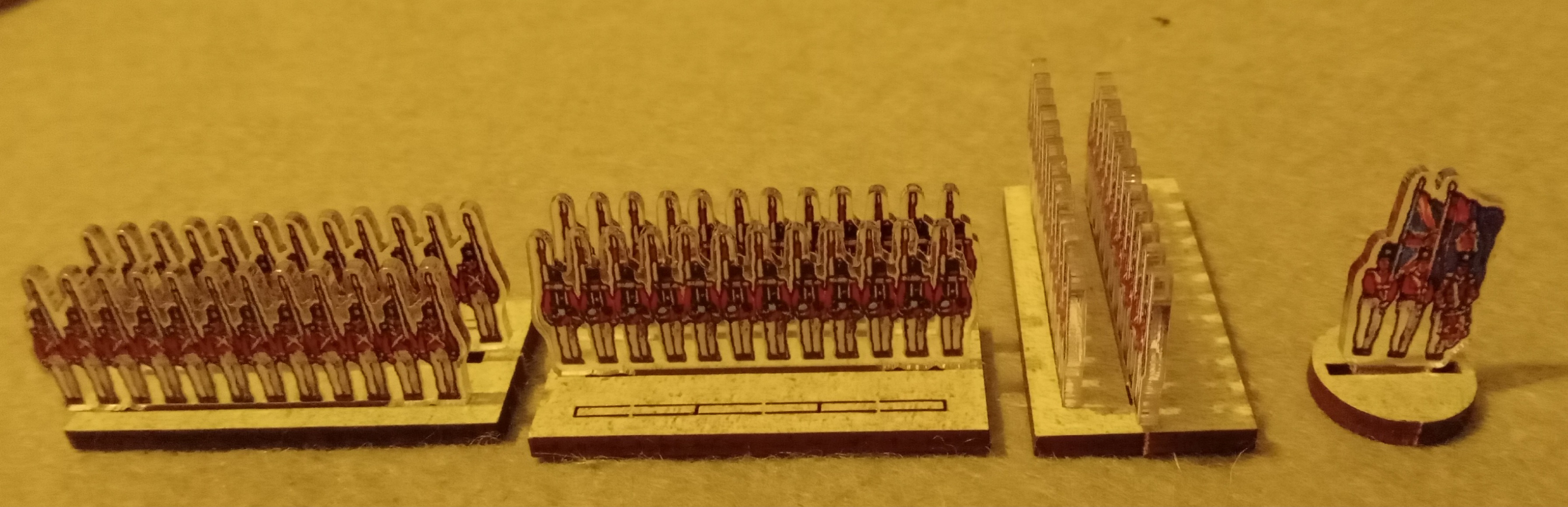
Front, rear and side views of British infantry, plus a command base
Infantry - and cavalry, for that matter - start with a strength of 3, so three bases make a unit, fitting nicely on a hex, with a command base for added colour
Front, rear and side views of French cavalry, plus a command base
French cavalry arranged as a full-strength unit on a hex
Front and rear views of French artillery
Artillery are fiddly to put together, but thankfully they have a strength of only 2, so a unit fits easily on a hex

An army needs a general, and here is Sir Arthur Wellesley, the future Duke of Wellington

Thursday, October 17, 2024

More Napoleonic Wargaming - Part Two

NATURALLY a battlefield needs scenery, and in the case of the first scenario in Mike Lambo's Battles Of Napoleonic Europe, the scenery consists of a village, six woods or copses, a stream or river, a six-hex ridge of high ground and a single-hexed hill at the bottom-right of the map.
Map of the battlefield
Part of my original order of Hexon II from Nottinghamshire-base Kallistra included hill hexes.
My basic battlefield grid, with hill hexes added

I already had plenty of suitably sized trees in my collection

With the village of Roliça added

The river is cut from blue felt bought at a Hobbycraft store in Hull
I am very pleased with the final result - well worth the money and time spent on it.

Wednesday, October 16, 2024

More Napoleonic Wargaming

I HAVE decided to refight the 20 scenarios from Mike Lambo's solo wargaming book Battles Of Napoleonic Europe ... but with a twist.
This time, instead of using the maps and counters supplied in the book, I plan to refight the scenarios with 10mm model soldiers on a hex grid laid on top of one of my wargaming tables.
Lambo's maps use a grid that is 10 hexes wide and eight or nine hexes deep, as shown in the following image.
Map for the book's first scenario, in which the player commands Anglo-Portuguese forces advancing from the bottom of the map
My first task was to recreate the basic grid, and I have done this with textured hexes, a system known as Hexon II, from Nottinghamshire-based Kallistra.
The hexes measure 100mm (3.9in) across, and I chose ones coloured to give a grass-and-earth effect.
Here is my first order, straight out of the box and upside down, but showing how they come in groups of six
I got my order hopelessly wrong in that I ordered far too many sixers, and anyway could not make the required grid with them alone.
So I had to order some individual hexes to complete the exact grid, which I felt was worth it, although I could have easily put together enough sixers to make the grid and simply ruled that certain hexes were out of bounds.
The finished grid (the hexes are held together by out-of-sight clips) with Lambo's book alongside
To be continued

Friday, October 11, 2024

Midianite Camelry

I have painted my first batch of 10mm Midianite camelry from Newline Designs

Sunday, October 06, 2024

Tart

HAVE just finished a great read by Peter Fleming, older brother of James Bond creator Ian, which I spotted in a branch of Oxfam for £2.25.
News From Tartary is his account of a seven-month journey from Peking, as China's capital was commonly known in 1935, to Kashmir in what was then the British Raj.
The 3,500-mile trip was conducted while a Times correspondent, and involved much desert traveling in tough and often tedious conditions.
Some of the tediousness comes through in the book, but mostly it is an engaging and revelatory read.
Travel classic
There is not a lot of military history per se, but there is quite a bit about the state of warfare between various Chinese factions, particularly the Nationalists, those paying lip service to the Nationalist cause, and those groups controlled or heavily influenced by Moscow.

Sunday, September 29, 2024

More Chariots

I have painted (best viewed from a distance) my second batch of 10mm chariots from Old Glory

Friday, September 13, 2024

Hebrew Chariots

I HAVE painted my first batch of 10mm chariots from Old Glory as part of my biblical project.
Two-horse chariots with two-man crews
They are painted to be suitable for Davidic, Solomonic and later Hebrew armies, and for their contemporaries.
The chariots certainly have a less-lightweight appearance than the Egyptian ones I obtained from Magister Militum, but are much easier to put together, and of course styles varied between nations and over the centuries.
I do not like the crews, which are moulded in one piece, but I suspect they will look fine from a distance as part of an army (the same could be said of my painting skills). 

Tuesday, September 10, 2024

Slingshot Issue 353

THE July/August edition of the journal of the Society of Ancients is even more than usually interesting.
Slingshot  - great issue
Highlights for me include the first part of a series on a battle in AD 685 between Northumbrians and Picts, the playthrough of a War of the Roses scenario for the society's new ruleset Blood Red Roses, a little-known way to temporarily base figures with museum wax, and a review of intriguing new ruleset Age Of Penda.