Thursday, February 20, 2025

On The Table - Turn One

Overview of the battlefield from behind the Egyptian lines
We dice to see who moves first, and I win 6-4.
I order every Assyrian unit to advance at heavy-infantry pace, ie two hexes.
After the Assyrian advance
Unlike in many rulesets, an army's units in the Ancients Portable Wargame do not all move and then all shoot (all that can and want to, that is).
Instead each unit is activated individually, ie it moves and shoots, or shoots and moves, or just moves, or just shoots.
There is a penalty to moving in the same turn as shooting - movement is reduced by one hex.
But there is a bonus for shooting without moving, and I will come to that later.
Pharoah's right-flank chariots could move their full three hexes, which would put them in range of the slingers in the town and of the Assyrian heavy cavalry.
But they would be unable to shoot as troops who use up their full movement allowance cannot fire.
Instead the chariot squadrons could advance two hexes, but then they would be out-of-range as chariots only have a shooting range of two hexes, which is the same as for javelin-armed cavalry and infantry, rather than the three hexes of bow-armed cavalry and infantry.
Why chariots are discriminated in this way is not explained - all we are told is that chariots (and war elephants) "are assumed to be carrying missile-armed crews," without the type of weapon being specified.
I have ideas about possibly modifying this and other aspects of the rules, but I will not go into that until after the battle - first we want to play the rules "as is."
Pharoah decides to advance his extreme-right squadron one hex, but leaves the other where it is, ensuring neither can be charged by the heavy cavalry next turn (heavy cavalry, like chariots, can move three hexes).
The spear-armed heavy infantry next to them also advance a hex, and the javelin-armed open-order infantry enter the rough ground (only light infantry and light cavalry can enter rough ground, and their movement rate is reduced to one hex a turn).
On the Egyptian left are two units of close-order archers, who count as light infantry and so have a movement rate of three hexes.
Pharoah orders the more-central archers - they happen to be marines - to advance two hexes and shoot at the Assyrian heavy infantry directly ahead, who are three hexes away (maximum range for bows).
No modifiers apply, so Pharoah rolls a die, needing 5+ to score a hit (this is always the requirement for weapon shooting), but he gets a 1.
The left-flank heavy infantry also advance two hexes, as do the other close-order archers, who fire at a camel squadron directly ahead. This time Pharoah rolls a 3 - still not good enough.
Both left-flank chariot squadrons advance onto the nearby hill, there being no penalty for hill movement.
Finally, Pharoah personally advances and joins the hex occupied by the marine archers, presumably hoping his presence will improve their aim next turn.
The Egyptians are holding back on their right, but pushing forward in the centre-left

Wednesday, February 19, 2025

On The Table

IT is one thing painting figures, quite another getting the figures on the table.
However my regular wargaming opponent ('Reg') and I are in position to do just that.
We will be killing several birds, as it were, with one game.
1. Fielding some of my recently painted Assyrians, together with Bedouin camelry.
2. Using recently bought and/or painted pieces of scenery.
3. Trying the ancient rules from Bob Cordery's Developing The Portable Wargame.
4. Testing the suitability of my Hexon II gridded terrain for 10mm ancients.
Cordery's rules, including army lists and combat examples, take up almost 40 pages in his book, but are considerably simpler than this might suggest.
Infantry and cavalry are divided into light and heavy types, while chariots are "mobile platforms for missile-armed troops" that can also be used for "battering weakened heavy infantry."
The rules do not mention camelry, but I feel fairly confident in my ability to follow Cordery's advice and make up my own rules for them.
Accordingly camelry will have the same strength-point-value as light cavalry, ie two, but will move at the speed of heavy cavalry, ie three hexes.
They will have the same double-move capability as other light troops, and their bow range will be the normal three hexes.
Any cavalry or chariot unit in close combat while in a hex adjacent to camels will suffer a -1 modifier.
The battle will see an Assyrian force, with Bedouin allies, face an Egyptian army, and since I commanded the Egyptians in our Biblical Dry Run battle, Reg has agreed this time he will play at being Pharoah.
We will each secretly choose an army with a maximum value of 40 strength points from a list that includes units of heavy infantry (4SP), slingers (2SP), javelin-armed light infantry (2SP), chariots (2SP), heavy cavalry (3SP), camelry (2SP), close-order archers with heavy armour (4SP) and close-order archers with light armour (3SP).
In addition each army must have a commander, whose notional strength-point-value of six is important for calculating when an army becomes exhausted, after which it can no longer take offensive action.
Here is my army.
Commander = 6pts
Heavy Infantry* x2 = 8pts
Close-Order Archers (heavy armour) = 4pts
Heavy Cavalry = 3pts
Bedouin Camelry x3 = 6pts
Chariots x4 = 8pts
Light Infantry (slingers) x2 = 4pts
Total: 39pts
Reg has revealed his choice as follows.
Commander = 6pts
Heavy Infantry x4 = 16pts
Close-Order Archers (light armour) x2 = 6pts
Chariots x4 = 8pts
Mercenary javelinmen x2 = 4pts
Total: 40pts
*The Assyrian heavy infantry are professional mixed units of spearmen and archers. They can shoot, but also enjoy the +1 modifier of heavy infantry in melees.
Each unit has the same number of bases as it has strength points, so heavy infantry (4SP) have four bases, while slingers (2SP) have two bases.
The exception to this rule is commanders, who are represented by a single base.
Each player can name two units as being elite (their strength-point-value is increased by one), and must designate two units as poor (their strength-point-value is decreased by one).
Elite units will be indicated on the table by having a small rock placed at the front of the hex they occupy, showing their SP is one more than the number of bases.
Poor units will be indicated on the table by having a small rock placed at the rear of the hex they occupy, showing their SP is one lower than the number of bases.
I have given elite status to two squadrons of chariots, while designating two of the camelry units as poor.
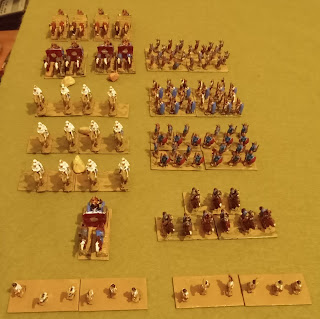
Assyrian army - 13 units, plus the commander
Reg announces two of his chariot squadrons are elite, and the javelin units are poor.
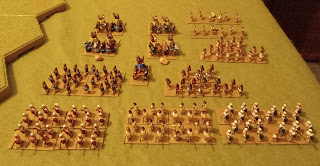
The Egyptian army consists of 12 units, plus Pharoah in a blue - the colour of Egyptian royalty - chariot

An elite Egyptian chariot squadron deployed on the table
Note that strength points are not an indication of a unit's fighting ability, but rather how many hits a unit can take before it is removed from the table.
This is particularly to be remembered in the case of an army general, who is rated as 6SP but has no offensive capability by himself.
However, if in the same hex as a friendly unit, the general gives a +1 modifier to the unit's combat-dice throws. But there is a drawback - if the unit is eliminated, the general goes with it.
What the rules do not state is what happens if an enemy unit can shoot at an enemy general, or engage him in hand-to-hand fighting, when he is alone in a hex.
We have decided that if a commander suffers a hit, it is resolved as for a hit on an elite unit, but only one hit will be needed to eliminate him, although his loss will cause his army to lose six strength points (and so bring it much nearer to exhaustion).
The basic battlefield is formed of 12x10 Hexon II hexes, each 100mm across.
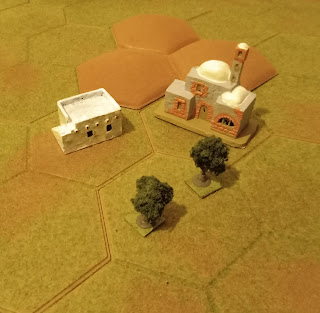
The battlefield is mainly a cultivated plain, with two bare hills, a small town with an orchard, a village and a three-hex patch of rough ground
Close-up of the town - the main building came from the Christmas decorations section of a Chinese store in Altea, Costa Blanca (inside the packet, along with what may be an anachronistic mosque, were a giant hen and chick, the adult being taller than the building!) 
We diced for choice of baseline, Reg winning 4-2 and choosing the side nearer the camera.
Normally we each draw a sketch map of our planned dispositions, but with hexes it is easier to number the hexes and assign units accordingly by writing down a number for each unit.
We agreed that all units must start in the first two rows.
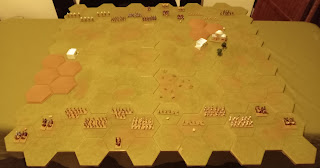
Overview of the battlefield, with the Egyptians nearer the camera
One of the first things that springs to mind - to me, anyway - is that, thanks to the hex system, the battlelines are not exactly straight.
Perhaps this does not matter overmuch, but Reg and I have agreed that next time we we might try turning the battlefield 90 degrees.
But there are problems with doing that.
For starters, troops would not move directly forward, but rather in a sort of zigzag, and there would be difficulties in lining up opposing units for melees.
It is certainly something we will have to give serious consideration to before coming to a final decision.
Returning to the battle, and before it commences, there is the question of terrain effects.
Built-up areas, woods (an orchard in this case) and hills are covered in the rules, but rough ground is not mentioned.
We will treat it as a wood for movement purposes, meaning only light infantry (and, theoretically, light cavalry, not that either side has any) can enter it.
A unit entering the rough ground must immediately stop, and can only move a single hex while in it, but there is no reduction to shooting ranges. Rough ground does not count as cover, and there is no -1 modifier for close combat.
View from Pharoah's chariot

Close-up of the Assyrian centre
As usual I will write up the battle as it unfolds.

Tuesday, February 18, 2025

Sunday, February 16, 2025

Slingshot Issue 356

THE Jan/Feb edition of Slingshot, the magazine of the Society of Ancients, has a striking, if rather well-known, illustration on the cover.
Tasty outside ... and tasty contents too
There is much I found interesting, with perhaps the best being Jim Webster's article on recruitment for Persian Achaemenid armies.
I knew the empire was effectively organised on feudal lines, but I knew few details.
It never takes me long to read Slingshot, but I always feel I have got my money's worth.

Saturday, February 15, 2025

Latest Painting Job

Assyrian close-order armoured archers - 10mm figures from Newline Designs
 

Friday, February 14, 2025

Bargain Trees

ONE advantage of being on emailing lists is that every so often you spot something you have been searching for fruitlessly.
That was the case when Hannants alerted me to a newly arrived product from Pegasus Hobbies of California.
Palm Trees (Style A)
The box contains five trees, designed as small palms for 1/72 and 1/87 scale.
I felt that for my 10mm biblical project they would make full-size palms, albeit a little on the tall side.
The box warns "some assembly required," and this proved very true.
Tree trunks need moulding nodules removed
The canopy branches also have large nodules, although these were easily removed with ordinary household scissors
Canopy with nodules cut off
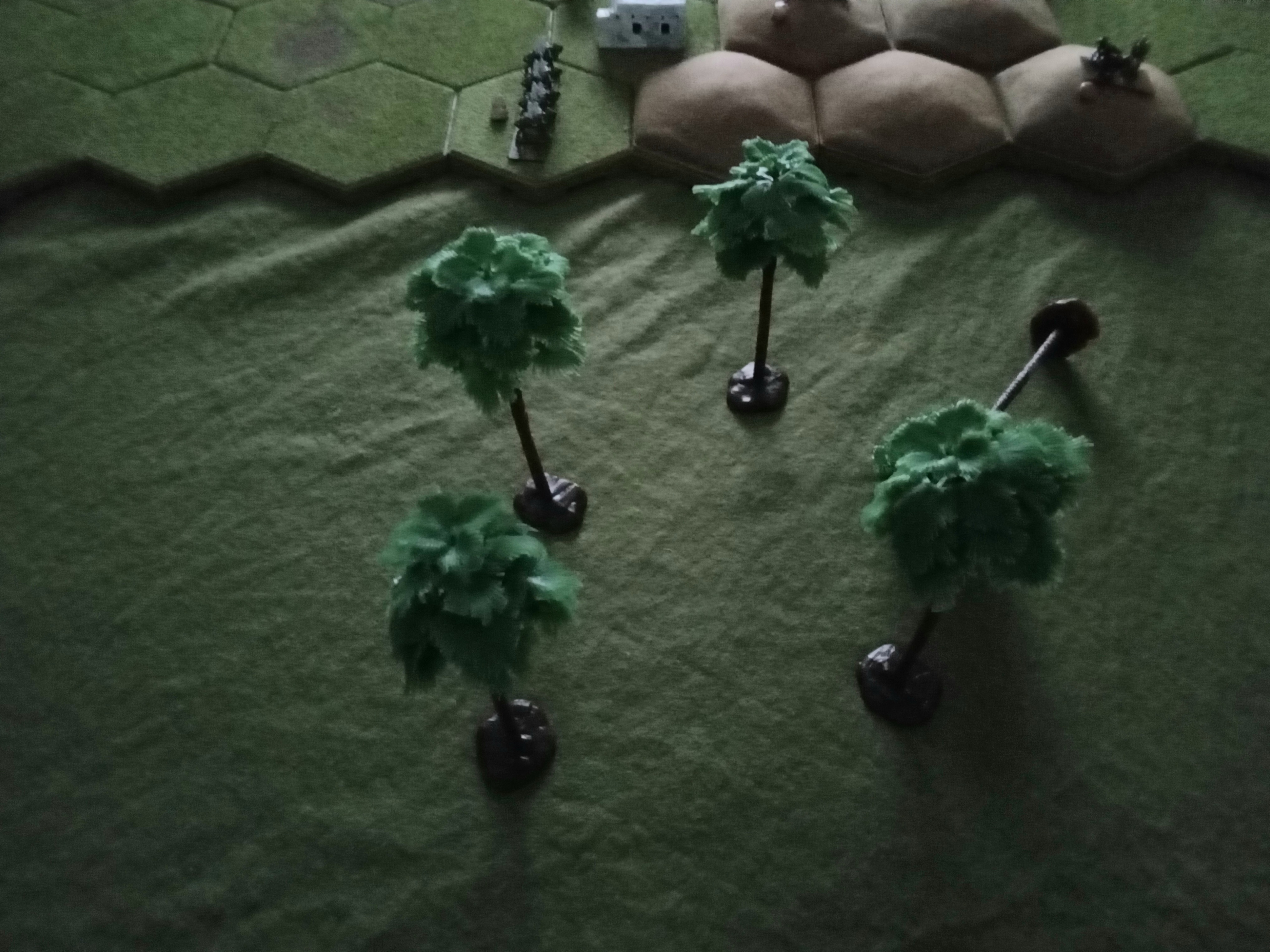
The finished trees look fine, but do suffer from balance issues
This 'moonlit' shot gives a better impression of the trees' true colours - note 10mm figures in the background
I am quite pleased with the result, especially considering the five trees cost £11.99 (plus postage), which works out much cheaper than palm trees from other specialist modelling stores.
However, while the trees are to scale, there is a sort of convention in wargaming that trees on the tabletop are usually much shorter than they would be in real life.
Certainly the palms might look odd if other trees were deployed on the same battlefield, but perhaps this will not prove a common scenario.

Thursday, February 13, 2025

Wednesday, February 12, 2025

Summing Up Vimeiro In 3D

I WAS too clever by half, or, to put it another way, too greedy.
My plan last time, in my second playthrough of the scenario, which saw my cavalry occupy Vimeiro Hill as soon as possible, had worked well.
But this time I tried to refine the plan by putting my cavalry on the Allied left flank, the idea being to clear the way for my infantry to occupy the hill as soon as possible.
The plan failed spectacularly, with Allied control of Vimeiro Hill never being absolute.
My lead in this 3D series has been cut to 3-2, whereas at this stage the first time through I was losing 2-3 (or tied 3-3 if my win in the replay of this fifth scenario is counted).

Tuesday, February 11, 2025

Battle Of Vimeiro In 3D - Turn Eight

Map

Situation after turn seven
My three activation dice land 6, 4 and 2. I reroll 2, which becomes 5, and I turn wildcard 6 into 3.
In area 3 my infantry fire at General Junot, the two dice increased thanks to support from Sir Arthur Wellesley, but decreased as the French commander is behind cover in Vimeiro. The dice land a disappointing 3 and 1.
In area 4 Sir Arthur climbs the hill and from it attacks General Junot. The two dice are increased for being on higher ground, but decreased thanks to the opposing general enjoying cover. I roll a pair of 5s, killing Junot.
In area 5 the infantry advance diagonally left.
The killing of the French commander offers me a glimmer of hope, but Sir Arthur is very vulnerable
The AI's four activation dice land 4, 3, 2 and 1.
In area 1 the infantry the roll 4, advancing from Maceira.
In area 2 the infantry roll 4, but do not advance as it would mean leaving high ground.
In area 3 the forward infantry fire at my infantry directly ahead (they cannot fire at Sir Arthur as line-of-sight is blocked by the village of Vimeiro). The dice land 4, 2 and 1, forcing my men back a hex. The rearward infantry advance diagonally left, firing at Sir Arthur. The three dice are decreased for shooting after moving, but they roll 6 and 1, killing the Allied commander.
The artillery roll 3, which has no effect.
Both armies are leaderless
More to the point, none of my units can occupy Vimeiro by the end of turn 10, so I concede.

Monday, February 10, 2025

Battle Of Vimeiro In 3D - Turn Seven

Map

Situation after turn six
My three activation dice land two 3s and 2. Since I really want 5 and 4, I reroll all three, getting 6, 5 and 4.
After turning wildcard 6 into 3, I start in area 3 by firing at the French infantry directly ahead of my men, the three dice landing 5, 3 and 2, eliminating one enemy base.
In area 5 my infantry move diagonally onto Vimeiro Hill, firing at the French already there. The four dice are decreased for shooting after moving, and they land 5, 4 and 3, eliminating the one-base enemy.
In area 4 my cavalry attack the French cavalry in Vimeiro, their two dice decreased for the enemy being in cover, and I roll a useless 3. The infantry advance and attack the same target, their three dice increased for attacking from an adjacent hex after moving. I roll 6, 5 and 1, easily destroying the one-base enemy and so clearing Vimeiro of French troops. Sir Arthur Wellesley advances one hex.
It is starting to look good for the Allies
The AI's four activation dice land 4, two 3s and 1. A 3 is rerolled, but does not change.
In area 2 the infantry roll 2, meaning they move onto higher ground to be nearer Vimeiro.
In area 3 the forward infantry fire at my cavalry, the two dice increased thanks to support from General Junot, and they roll two 5s and 2, eliminating my unit. The rearward infantry roll 6, but are unable to move nearer my furthest-forward unit.
In area 4 General Junot enters Vimeiro and attacks my infantry beside the village. A commander counts as one-base cavalry (presumably he has an escort), which means four dice, and they fall as three 5s and 2, eliminating my unit! The artillery roll 6, advancing (at last).
A dramatic change of fortune