Wednesday, April 12, 2023

Four-Player Empire: Turn Nine (270-260 BC)

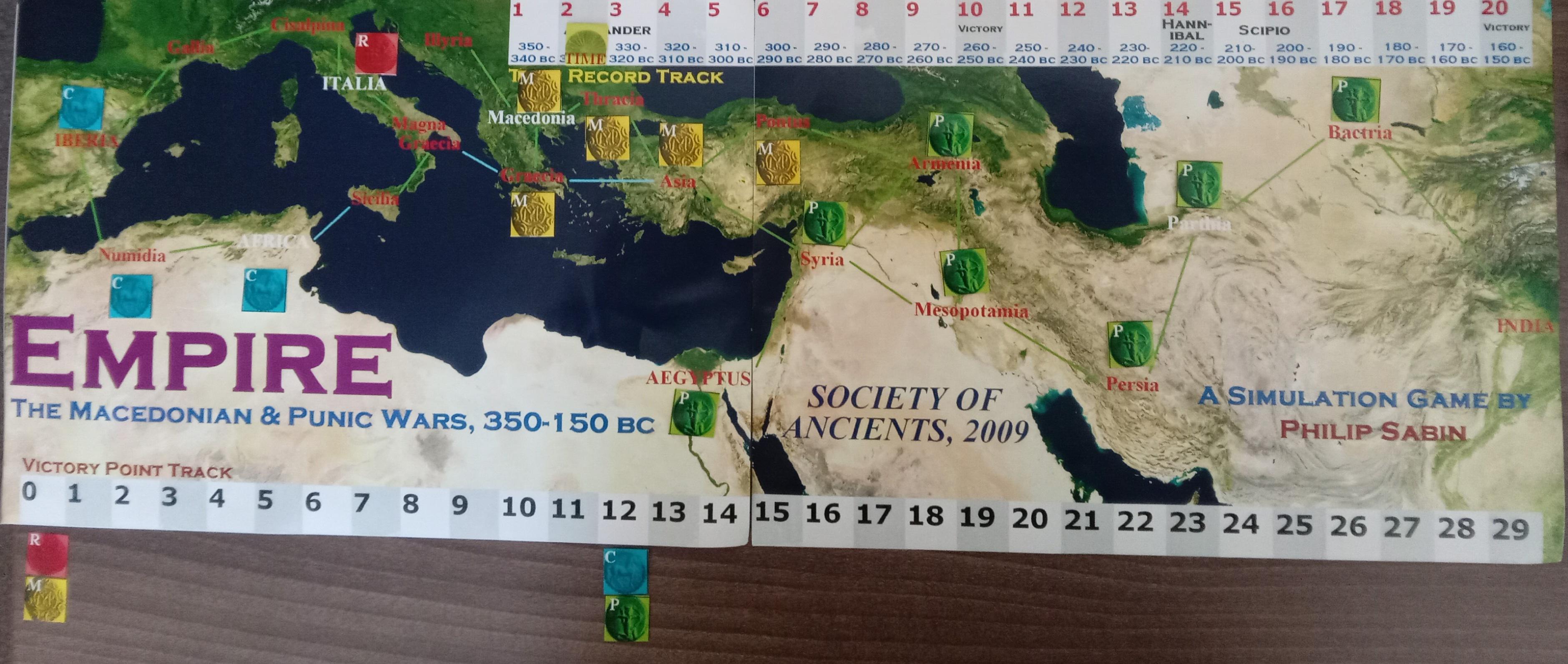
Situation in 270 BC
The revolt phase sees newly conquered Bactria throw off Macedonian rule and become independent.
Carthage is drawn first. I can attack independent Gallia or Roman-controlled Magna Graecia. Both are outside Carthage's original empire, and so attract a -1 modifier. Gallia attracts a further -1, because of tribal unrest in the first 10 turns, but Magna Graecia also attracts -1 because it is a controlled province.
Since the chances are the same, I attack Magna Graecia, hoping to set back the Romans, but roll a miserable 1.
The Romans are up next, and they attack Sicilia, rolling a 5, which is enough, despite a -1 modifier for attacking a controlled province.
The Parthians fail to regain their homeland, rolling a 4.
That leaves the Macedonians, who attack Bactria, rolling a 3, which is not enough as they no longer get a +1 modifier for having had a great captain no more than five turns ago.
Rome is a sea-crossing away from the Carthaginian homeland province of AFRICA

Tuesday, April 11, 2023

Four-Player Empire: Turn Eight (280-270 BC)

Situation in 280 BC
My joy at the end of the last turn at seeing Carthage gain respectability in terms of provinces conquered is dispelled when Numidia revolts for the second time.
The Macedonians are drawn first, and easily conquer Bactria, eliminating the last Persian-controlled province. If the Persians return (by successfully fomenting rebellion in their homeland of Parthia) they will be known as Parthians, and I shall refer to them as such from now on.
Rome is drawn next, and Richard again attacks Sicilia, but rolls a lowly 2.
The Parthians roll a 5, one short of the 6 needed to create a rebellion in their homeland.
Finally I again reconquer Numidia, thanks to a roll of 4.
The Persians are gone

Monday, April 10, 2023

Four-Player Empire: Turn Seven (290-280 BC)

Situation in 290 BC
Two 2s are thrown in the revolt phase, meaning Armenia has thrown off Macedonian rule.
Carthage is drawn first, and I naturally attack Numidia, rolling the minimum 4 required.
Rome is up next. Richard could attack independent Cisalpina, although there is a -1 modifier for attacking an independent Cisalpina - the same applies to Gallia - on turns one to 10. Alternatively he could attack Carthaginian-controlled Sicilia, which again attracts a -1 modifier, this time for being a controlled province.
Richard opts for Sicilia, hoping to do me a bad turn, but he rolls a 4, which is one short thanks to the modifier.
The Macedonians are drawn next, and they easily reconquer Armenia.
The Parthians roll one short of fomenting revolt in their homeland.
Carthage at last starts to look respectable

Sunday, April 09, 2023

Four-Player Empire: Turn Six (300-290 BC)

Situation in 300 BC
Revolt-dice rolls of 1 and 6 see Numidia throw off Carthaginian rule.
The Macedonians are drawn first, and they attack the Persian homeland of Parthia. A roll of 4 is enough as the -1 modifier for attacking a controlled province is cancelled by the +1 modifier for having had a great captain no more than five turns ago.
Rome is up next, and it conquers Magna Graecia on a throw of 4.
Carthage is next, and naturally I opt for trying to reconquer Numidia, but narrowly fail by throwing 3.
That leaves the Persians, who from now on I will refer to as Parthians. Their first task is to foment revolt in their homeland of Parthia, needing a 6 to regain control, but 4 is rolled.
The Macedonians control 11 provinces, including another people's homeland, but the sleeping giant that is Rome is stirring

Saturday, April 08, 2023

Four-Player Empire: Turn Five (310-300 BC)

Situation in 310 BC
The revolt dice land for a third time on Sicilia, which is still independent, and so there is no effect.
The Persians are drawn first, and they roll a 6, easily reconquering Macedonian-controlled Persia.
Rome is next, and a roll of 1 means ITALIA is consolidated, putting the Romans in position to expand from next turn.
The Macedonians successfully reconquer Persia, while I at last conquer Sicilia, thanks to throwing 6 for the naval crossing and 5 for the attack on the province, which is enough despite Carthage's -1 modifier for attacking outside of its original empire.
The west comes alive, just as the east seems to have reached stalemate

Friday, April 07, 2023

Old Bones

MY latest read is not really a history book, or at least not a book about military history, but Written In Stone - The Hidden Secrets Of Fossils And The Story Of Life On Earth by Brian Switek is the most interesting publication I have come across in a long time.
Ancient but and fascinating
First published in the US in 2010, I bought the UK edition for a bargain £2.25 in Oxfam's shop in Bethnal Green Road, London E2.
The book - its contents are amply explained by the title - received multiple good reviews, and I soon learnt why. Highly recommended.

Four-Player Empire: Turn Four (320-310 BC)

Situation in 320 BC
The revolt dice fall on independent Cisalpina, meaning there is no effect.
The Persians are drawn first. They attack the Macedonian-controlled province of Persia, rolling 4, which is narrowly not enough as they suffer a -1 modifier for attacking a controlled province.
I am drawn second, again try to invade Sicilia, and again fail at sea; then Richard rolls a 5, again failing to consolidate ITALIA.
The Macedonians are drawn last. They no longer have Alexander, but for the next five turns receive a +1 modifier for having had a great captain no more than five turns ago,
They attack Armenia, rolling a 4, which is just enough as their +1 modifier cancels out the -1 modifier for attacking a controlled province.
The Macedonian empire continues to expand, and as yet there is no threat to their rear

Thursday, April 06, 2023

Four-Player Empire: Turn Three (330-320 BC)

Situation in 330 BC
The revolt phase sees two 6s thrown, meaning more woe for Andy as Thracia throws off Macedonian rule.
Since the Macedonians go first as this is the second of the two turns in which they have Alexander the Great, Thracia is immediately reconquered, followed by Syria, AEGYPTUS, Mesopotamia and Persia (but remember this province is not the Persians homeland; rather Parthia is).
The Persians are drawn first, and they attack the province of Persia, but roll 2.
I am drawn next, and launch a third attempt to conquer Sicilia, but it fails on a naval-crossing roll of 1.
Richard, seeking to consolidate ITALIA on a roll of less than the turn number of three, throws a 4.
The west remains quiet, while it seems the Persians will survive the Macedonian onslaught

Wednesday, April 05, 2023

Four-Player Empire: Turn Two (340-330 BC)

Situation in 340 BC
The revolt phase again falls on Sicilia, and so again has no effect, but perhaps is a warning of trouble for anyone who attempts conquering the province. 
This is the first of two turns in which Alexander the Great appears as a great captain, meaning the Macedonians go first and get to launch five campaigns instead of the usual one.
They also get a +2 modifier, and great captains do not suffer the normal -1 modifier for attacking a province controlled by another of the four powers, except if attacking a homeland province.
Alexander only benefits from avoiding the -1 modifier if the Macedonians control Graecia, and so that is attacked first this turn.
But then it takes Alexander two campaigns to conquer Thracia, before using the remaining two campaigns to take Asia (that is the province name in the game, although it only covers part of Asia Minor) and Pontus.
The result is the Macedonians have added four provinces to their domains, but Andy is looking glum as he had hoped to be doing better at this stage (in my solo game the Macedonians conquered Graecia on turn one, with Alexander taking Thracia, Asia, Syria, AEGYPTUS and Mesopotamia on turn two).
Great captains always go first, so now the rest of us draw for next move - the choice is Rome. A 1 is needed to consolidate control of ITALIA on turn two, but the roll is an agonising near-miss with 2.
I am drawn next, and again try to invade Sicilia. This time the naval crossing is not a problem, and for the attack I roll a 4, which is not quite enough as Carthage suffers a -1 modifier for campaigns outside its original empire.
The Persians attack Macedonian-held Pontus, but roll a 2.
Conflict in the east, but the west has seen no change

Tuesday, April 04, 2023

Four-Player Empire: Introduction & Turn One

AFTER my solo games of Philip Sabin's Empire late last year, I was excited to try a four-handed version, and I have now assembled the players.
As well as myself and my regular wargaming opponent, there are two of our mutual friends: Richard Johnson, a security consultant, and Andy, a serving officer in Britain's armed forces.
I explained the basic rules of the game, which is set in an extended Mediterranean world from 350-150 BC, here.
How our part of the world looks in 350 BC - Persians dominate the east and Carthaginians rule the west, but Rome and Macedon are poised to rise 
As usual I will write up the game turn by turn, and the first thing to do is to draw for sides.
*****
I have drawn Carthage, my regular opponent has drawn Persia, Richard has drawn Rome, and Andy gets Macedon.
TURN ONE (350-340 BC)
The revolt dice pinpoint Sicilia, but as that is already independent there is no effect.
Rome is drawn first, but cannot do anything as the Romans first need to consolidate their control of ITALIA, and to do that they must roll a score lower than the turn number, which is impossible on turn one.
The Persians are drawn next, and they make the obvious choice of attacking AEGYPTUS, which counts double victory points and is the only province they can attack outside of their starting empire without suffering a -2 modifier. The roll is a very convincing 6 (4 or more is needed).
The Macedonians attack Graecia, which they must have if they are to get the best out of having a great captain  (Alexander the Great) on the next two turns, but they narrowly fail with a roll of 3.
I attack Sicilia, but the expedition is a fiasco as the fleet is apparently lost at sea (I roll a 2, when 3 or more is needed).
Situation at the end of a turn in which only Persia has prospered