Friday, December 06, 2024

Biblical Dry Run - Turn Six

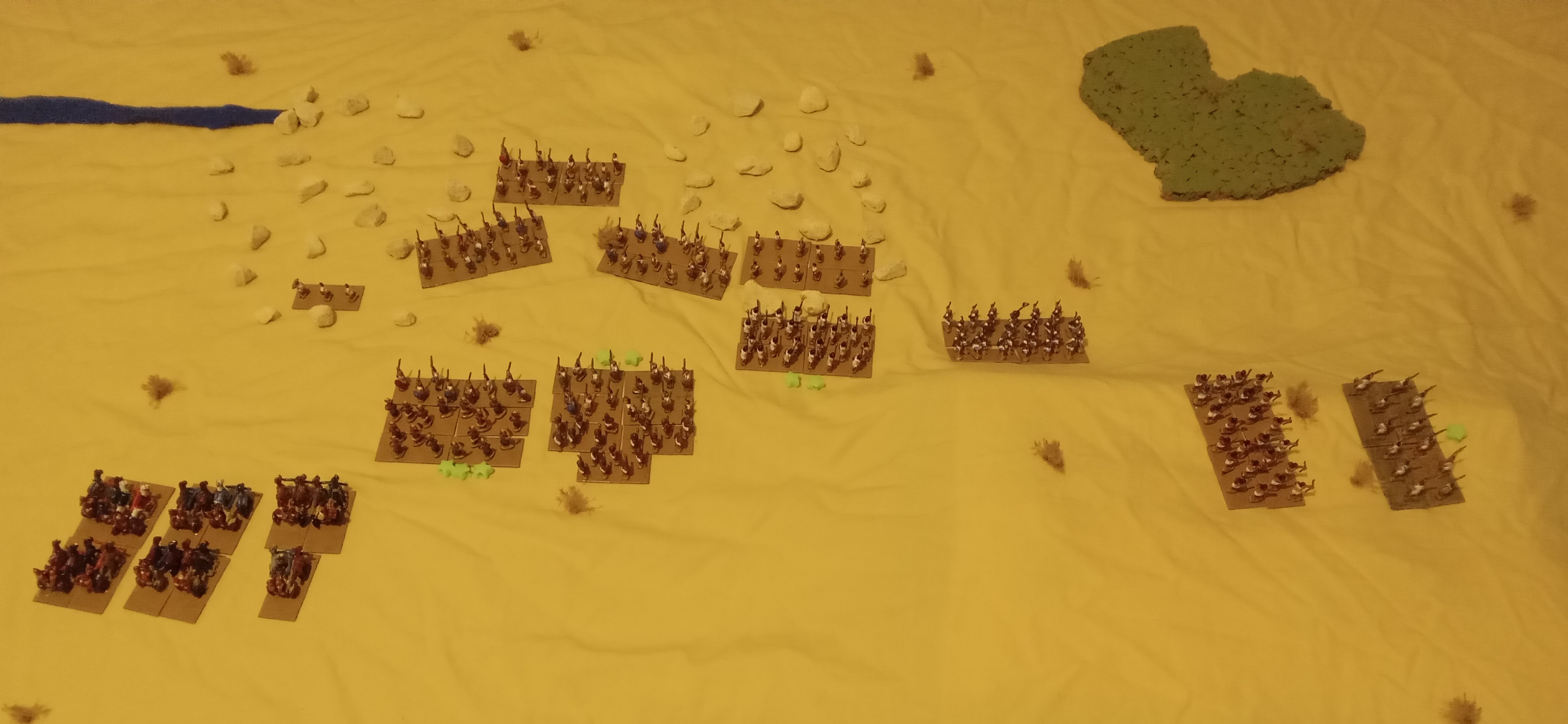
Situation at the start of turn six
Hebrews
Reg declares a charge by his left-most auxiliaries against my two-base spearmen. Part of his unit has to pass through rocky ground, but auxiliaries are not affected by this and so the charge easily strikes home. There is no charge-bonus under the rules, but the auxiliaries have four bases against the spearmen's two. Reg rolls 4, 2 and two 1s - one hit. I roll 6 and 2 - also one hit. Neither hit is negated even though we both roll a saving throw of 5 (troops with light armour are only saved by a 6).
The Hebrew auxiliaries in the rocky ground opposite my chariots fall back as far as they can, which is 6cm (they lose half their maximum move for turning, but are unaffected by the terrain). The one-base Benjaminite slingers line up alongside them.
The other unengaged auxiliaries shuffle forwards and sideways slightly, presumably preparing to charge my Sherden if the latter, as seems likely, prove victorious in their melee against the Ephraimites.
The Gadites on the hill throw their javelins at my archers, who have formed a defensive circle, scoring a hit, which is not negated. Being open-order infantry, the Gadites are allowed to fire and then move, a rule they take advantage of to flee from the direction of my approaching three-base chariot squadron.
The four-base Benjaminites shoot at my marine archers, but fail to register a hit.
In the melee between the Ephraimites and my Sherden, the former score one hit against the latter's two. None of the hits is negated.
In the other melee my marine spearmen score two hits, but the Simeomnites score three. No hit is negated, which means under totting up that both units lose a base. The Simeonites are elite, but that does not stop shaky morale causing them to lose another base (Reg rolled a 1). The marines also lose a base to poor morale, meaning both units are down to one base in what has been particularly bloody hand-to-hand fighting.
The battle still feels very much in the balance
Egyptians
My left-flank chariot squadrons move to the left of the rocky ground facing them, so as to keep the Hebrews in the rocky ground within mounted-bow range. The royal squadron (the main body of its chariots are painted blue, a colour chiefly reserved in Egypt for royalty) shoots at the Benjaminite slingers, scoring two hits. Thanks to the target being in cover, the hits are halved, and the remaining one is almost negated, but Reg rolls a 5 - one short of the 6 required for a saving throw by lightly armoured troops. My other left-flank squadron fires at the same target, scoring a hit, which is halved, and disappears on a 50: 50 chance.
My three-base chariot squadron mounts the hill in pursuit of the Gadites, and shoots at them, scoring a magnificent three hits, although one is cancelled by a saving throw.
The archers on the hill also shoot at the retreating Gadites, being allowed two dice as the former are in a circle. However they roll a pair of 6s, and neither hit is negated, so the Gadites lose a base, and a second one when their morale plummets (Reg rolled a 1).
My marine archers shoot at the full-strength Benjaminites, scoring a hit, which is halved for cover, and then disappears on a 50:50 chance.
There are three melees to resolve.
My Sherden inflict two hits on the Ephraimites, and suffer one in return. All the hits stand, which means the Ephraimites become the first unit to be eliminated.
In the bloody second melee the Simeonites score a hit, but I negate it with a saving throw of 5  (the marine spearmen have medium armour).
Finally my ordinary spearmen fail to inflict a hit, but the auxiliaries fighting them score three, one of which I manage to negate.
The tide of battle seems to have swung Egypt's way, especially since the Gadites must be regretting their earlier impetuousness

Thursday, December 05, 2024

Biblical Dry Run - Turn Five

Situation at the start of turn five
Hebrews
The one-base Benjaminite slingers withdraw through the rocky ground their full move distance of 12cm (light infantry are not penalised for turning).
The rearmost band of auxiliaries enters the same rocky outcrop, but beyond mounted-bow range of the Egyptian chariots.
The Benjaminite slingers in the other rocky ground also drop back, and then shoot at the spearmen ahead of them. The four dice land 6, 5, 4 and 2 - three hits. But these are halved as the Benjaminites' aim is obstructed by cover. A die throw shows the half-hit is rounded up, so two hits. My saving throws are to no avail, so my unit has suffered four hits in all, meaning it loses a base. Being biblical infantry, the unit has to take a morale test, and being of average quality a 4+ is needed to avoid losing a second base, but I roll a 2.
It was at this point that Reg muttes what sounds like a swear word under his breath as he realises he has failed to declare a charge with his auxiliaries nearest to my same unit, and since charges have to be declared at the start of a turn, he has lost his chance. This is an example of why Neil Thomas has no command-and-control restrictions in his rules. He reckons players make enough mistakes of their own to duplicate the blunders of real warfare. Reg instead contents himself with wheeling the auxiliaries to face my spearmen, perhaps hoping to charge them next turn.
The Gadite javelinmen on the hill are open-order infantry, so they are allowed to shoot and then move, which is what they do, inflicting two hits on my ordinary archers, neither of which is negated by my saving throws, and then moving to the right flank of the archers, meaning they cannot be shot at in my half-turn (more on this later).
There are two continuing melees,
In one my Sherden inflict a hit on the Ephraimites, who reply with two hits on my men, despite being down to two bases. Reg is unable to negate the hit his men suffered, but one of my saving throws lands a 5, which is enough as Sherden have medium armour, so the end result is one hit apiece. Unfortunately for the Egyptian cause, that brings total hits suffered by the Sherden to four, so they lose a base and have to take a morale test. Since they are elite, I only need to roll 3+, and they do pass the morale test (just - I roll a 3).
In the other melee my marine spearmen inflict two hits, but suffer three from the Simeonites. The latter cannot save either of the hits they suffer, which brings their total to four, and so they lose a base, but easily pass the subsequent morale test (Reg rolls a 6). Sherden have medium armour, which helps me negate two of the three hits they suffer (I roll 6 and 5),
The fleet-footed Gadites have got behind my army
Egyptians
Before I start my half-turn, we have a discussion about the situation between Reg's Gadite javelinmen and my close-order archers on the hill. Under the rules the latter cannot move and fire, which means the open-order Gadites can literally run rings around them with impunity. This is unrealistic, so we agree a house rule that lets a unit form a circle (much as Napoleonic infantry formed square when threatened by cavalry, or, to cite a nearer moment in history, much as the Spartans did at Thermopylae when awaiting the Persians' final attack).
Accordingly I start my half-turn by getting the archers to form circle, from which they will be able to shoot next turn. When firing at a target, they will be able to use two bases.
I order my two-base spearmen to withdraw (this means a 4cm move, ie half their usual allowance as biblical infantry).
I send my three-base chariot squadron to help the archers on the hill. Being light chariots, they suffer no penalty for turning, and so career 24cm along the back of my lines.
My other chariot squadrons advance to within bow range of the auxiliaries in the rocky ground, and shoot, but score just one hit. This is halved for the target being in cover, and the half is rounded down on a 50:50 chance, so no hits despite eight bases shooting.
My marine archers shoot at the Benjaminite slingers in the other rocky ground, scoring two hits. This is halved for the target being in cover, and even that is almost negated when Reg rolls a 5 - one short of the saving throw needed for troops with light armour.
In the longer-running melee, my Sherden roll three hits, while the Ephraimites score only one. None of the hits is negated, which means under tallying up the Ephraimites lose a third base, although their morale holds steady,
In the other melee my marine spearmen inflict two hits, and the Simeonites retaliate with one. I negate the marines' hit, but the Simeonites have no such luck.
Cavalry, or more-precisely chariots, are riding to the rescue of my under-fire archers

Wednesday, December 04, 2024

Biblical Dry Run - Turn Four

Situation at the start of turn four
Hebrews
Reg starts by declaring a charge by the Simeonite elite auxiliary infantry on my marine spearmen. Both sides get to roll one die per base. Reg rolls 5, 4, 3 and 2 - two hits. I roll 6, 5, 4 and 3 - three hits. My marine spearmen have medium armour, so a hit is negated on a saving throw of 5+, but I roll 3 and 1, and so two hits are shown by adding green beads behind my unit. The Simeonites have light armour, and so need saving throws of 6. Reg rolls 6, 5 and 1, negating one hit.
The Gadites on the Hebrew left are open-order infantry, which means they can turn as much as they like and still use their full movement allowance of 12cm. Accordingly Reg sends them on to the hill (hills have no effect on movement), outflanking my archers. Since they are armed with javelins, they can fling these. but the four dice land as two 2s and two 1s, so no hits.
The left-flank Benjaminite slingers shoot at my regular spearmen, scoring two hits, neither of which is negated.
The right-flank Benjaminites shoot at the chariot squadron nearest the Sherden. The Benjaminite unit is reduced to three bases, but scores two hits. I manage to negate one by rolling a 6, but since the squadron has now suffered four hits, it loses a base and must test its morale. Egyptian chariots are elite units, and I easily roll the 3+ required to avoid losing a second base.
In round two of the melee between the Ephraimites and my Sherden, both sides suffer hits, but this is more serious for the Ephraimites as under totting up hey lose a base and have to take a morale test, but Reg rolls a 5 to avoid further damage.
The Sherden are getting the upper hand against the Ephraimites
Egyptians
My regular spearmen are not quite within charging distance of the Benjaminites in the rocky ground ahead of them, but advance to reach the edge of the cover.
My regular archers turn to face the Gadite javelinmen, but having moved are not allowed to fire.
The marine archers descend from the hill, the idea being to take the nearby Benjaminites in the flank.
All three chariot squadrons shoot at the other band of Benjaminites, scoring seven hits. The Benjaminites enjoy the cover of rocky ground, so the hits are halved, but become four on a 50:50 chance for the half hit. Reg is unable to negate any of the hits, so the Benjaminites lose a second base, and then, perhaps not surprisingly, fail a morale test, losing a third base.
In round three of the melee between my Sherden and the Ephraimites, I score three hits to one, although one of the hits I inflict is cancelled by a saving throw. Nevertheless the cumulative effect is to remove a second base from the Ephraimites, although their morale holds steady.
In round two of the melee between my marine spearmen and the Simeonites, I fail to inflict a hit, but Reg scores four hits. Saving throws reduce those to two hits, but since my unit has already suffered two hits, a base is removed. However I roll the necessary 4+ (just) to avoid losing a second base due to failing morale.
The Hebrews are perilously close to being the first to lose a unit

Tuesday, December 03, 2024

Biblical Dry Run - Turn Three

Situation at the start of turn three
Hebrews
Having apparently decided they must eventually lose a purely shooting battle, the Hebrew auxiliaries continue to advance, as do the Gadites on the Hebrew extreme left.
The Benjaminites opposite the chariots again shoot at the squadron next to the Sherden, scoring two hits, both of which stand as my saving throws are a pair of 2s.
The other Benjaminites shoot at the marine archers on the hill, but their aim is poor (they roll two 3s and two 2s).
The Gadites, unfortunately for them, are not quite near enough to hurl their javelins at my archers (we had agreed ranges should be measured from the centre-front of the shooting unit).
After the Hebrew half-turn

Egyptians
I declare a charge, my Sherden attacking the Ephraimites.
Both units are auxiliaries, which means both get one die per base in the melee (there is no bonus for charging), with 4+ needed for a hit.
I roll two 5s, 4 and 1 (three hits), while Reg rolls two 6s, 3 and 2 (two hits).
My Sherden have medium armour, meaning a hit is negated by saving throw of 5+, and I roll 5 and 1, so my men suffer just one hit.
The Ephraimites have light armour, meaning only a 6 will negate a hit. Reg rolls two 5s and 4, so somewhat unluckily suffers all three hits.
Both my units of spearmen advance 8cm, and the remaining Egyptians stay where they are.
My three squadrons of chariots again fire at the Benjaminites ahead of them, scoring six hits.
That total is halved, thanks to the slingers enjoying the cover that comes from being in rocky ground.
Reg's saving throws land 6, 4 and 2, negating one of the three remaining hits, but that means the unit has now suffered four hits, so a base is removed.
Losing a base means the Benjaminites have to take a morale test, requiring 4+ to avoid losing a second base, and Reg rolls a 4.
My extreme-right archers fire at the Gadite javelinmen, rolling 6, two 3s and 1, but the hit is cancelled by Reg's saving throw of 6.
My marine archers also shoot at the Gadites, rolling 4, two 3s and 1, and this time the hit sticks.
End of turn

Monday, December 02, 2024

Biblical Dry Run - Turn Two

AFTER we played the first turn, I remembered I had recently visited Central London's Orcs [sic] Nest, where I bought a pack of spikey beige tufts by Gamers [sic] Grass.*
The tufts will have no effect on gameplay, but add a little something to the limited scenery
Looking from behind Egyptian archers on the hill
Hebrews
Reg orders the elite auxiliary Ephraimites and Simeonites to leave the rocky ground and fill the gap between the two bands of Benjaminite slingers.
Auxiliaries have a normal move of 12cm, but that is reduced by half if, as here, they deviate more than 30 degrees from straight ahead.
The ordinary auxiliaries behind them in the rocky ground advance to occupy the vacated space.
The other auxiliaries, and the Gadites in the rough ground, remain where they are, as do the Benjaminite slingers.
The slingers opposite the chariots shoot, concentrating on the unit nearest the Sherden. Their four dice land 6, 4, 2 and 1, meaning a hit.
Light chariots negate a hit on a saving throw of 5+, but I roll 2, so a green bead is placed behind the unit to show it has suffered a hit (four accumulated hits mean a base is removed).

Egyptians
I only move the archers, advancing them to the edge of the hill, and then order the charioteers to shoot again at the Benjaminites ahead of them.
The Royal Squadron on the extreme left rolls two 5s and two 1s. The two hits are halved, because the Benjaminites are in rocky ground, and this time Reg fails to roll the required saving throw of 6.
The middle squadron rolls 5, 4, 2 and 1 - two hits, decreased to one, and again the saving throw fails.
The remaining squadron rolls 6, 3, 2 and 1. That is one hit, which is halved, and disappears on a 50:50 chance when I can only roll a 3.
So the Benjaminites have suffered two hits, which are again shown by putting green beads behind the formation.
End of turn two
*Apostrophes are apparently unfashionable.

Sunday, December 01, 2024

Biblical Dry Run - Turn One


Battlefield with both armies deployed
Close-up of where the action is likely to be
The rules in Ancient & Medieval Wargaming seem to make no mention of the effect of rough and/or rocky ground, except to state that it provides "cover."
We agreed, however, that rocky ground should be treated as woods, which means it is impassable to chariots, reduces movement by close-order infantry to 4cm (their normal move is 8cm), but does not impede auxiliaries or open-order infantry.
Troops in rocky ground, as with troops in woods, will suffer half the normal number of hits from shooting, and melees are fought very differently from ones on open ground.
We will treat rough ground similarly, except it does not provide cover and so will not reduce hits from shooting 

Hebrews
Reg, having won the dice-off to decide who moves first, advanced the two columns of auxiliaries into the rocky patches, and also advanced, but more cautiously, the connecting unit of auxiliaries.
The Gadite javelinmen on the Hebrew left advanced to near the edge of the rough ground.
None of my men is quite within slingshot range (16cm), so the Hebrew turn ends here.

Before getting to my half-turn, there is the question of bow range to be considered.
Under the rules there are two ranges for archery - 24cm for troops on foot, 16cm for troops on horseback.
But what about charioteers armed with bows?
They are on foot in as much as they are standing on a mobile shooting platform, but the platform is being pulled by horses and so is not as stable as terra firma.
The rules do not clarify the matter, but it is clear from reading the preamble to the biblical section that it is the lessened stability of cavalry that lowers their bow range, and so I think it fair that the maximum range of chariot bows should be 16cm.

Egyptians 
Accordingly I advance all three of my chariot units so they are in range of the Benjaminite slingers in the rocky ground on the Hebrew right.
The infantry in the plain remain where they are.
On the hill I order my righthand archers to turn and advance to get alongside the unit of marine archers.
Close-order archers have a move of 8cm, but half of this is lost if deviating more than 30 degrees.
The rules do not explain the mechanics of this, but since pivoting would be a very slow process, it seems fairest to let the archers turn, and then advance 4cm, which indeed put them alongside their archer comrades.
After movement, but before shooting is calculated
My Royal Squadron, on the extreme left, shoots first. One die per base is rolled, 4+ being needed for a hit.
I threw 6, 5, 3 and 1 - two hits. However this is halved because the Benjaminites are in rocky ground.
In addition, all Early Hebrews have light armour, which means a saving throw of 6 negates a hit, and Reg does roll a 6.
My middle chariot squadron now shoots, rolling two 6s and two 1s. Again the two hits are reduced to one, thanks to the Benjaminites' rocky ground, and again the saving throw lands as a 6.
With my frustration mounting, my third chariot squadron shoots, rolling 6, 4, 3 and 2 - one hit. The rocky ground halves that, so I roll a die with a 50:50 chance of the hit standing, and a 5 means it does.
But believe it or not, Reg again comes up trumps with a saving-die roll of 6.
For anyone whose maths is not their strong point, the odds of negating all three hits was 215-1 against - no wonder I was quietly fuming!
The plucky (lucky?) Benjaminites' view of the massed Egyptian chariots, with Sherden to the charioteers' right

Saturday, November 30, 2024

Biblical Dry Run - Adding The Armies

BOTH players made a sketch map of where their forces - shown below - will be deployed.

My Egyptians
Chariots (Light, Bow, Elite) x 3
Bows (Close-Order Archers, Light Armour, Average) x 2
Spearmen (Biblical Infantry, Light Armour, Average) x 1
Marine Spearmen (Biblical Infantry, Medium Armour, Average) x 1
Sherden (Auxiliary Infantry, Medium Armour, Elite) x 1

Reg's Hebrews
Simeonites and Ephraimites (Auxiliary Infantry, Light Armour, Elite) x 2
Benjaminites (Open-order Infantry, Sling, Light Armour, Average) x 2
Gadites and Issacharites (Open-Order Infantry, Javelin, Light Armour, Average) x 1
Other Tribes (Auxiliary Infantry, Light Armour, Average) x 3

It is at this point that the ambush part of the Early Hebrews' guerrilla-warfare rule comes into effect.
This allows the Hebrew commander to place two units of open-order infantry anywhere on the battlefield after all enemy troops have been deployed.
There is no guidance in Ancient & Medieval Wargaming as to how armies should be deployed, so we agreed a rule that all but open-order troops must be placed in the four central sectors making up each player's half of the battlefield.
That leaves a sector each side that can only have open-order troops at the start of the battle, and you may recall a sector measures 30.5cm across.
We also agreed units must start within 20cm of their side's long edge of the table.

Egyptian Setup
I decided both my units of archers would be well-placed on the hill, but with one facing right in case of an ambush being launched from that direction.
To their left I placed the ordinary spearmen, then the marine spears, the Sherden and finally the three units of chariots, with the Royal Squadron slightly pulled back, again to guard against a quick flank attack from ambush.
Looking at my Egyptians from the Hebrew side of the battlefield
Hebrew Setup
Reg placed his javelinmen in the rough going on the Hebrew left.
He also created two columns of auxiliaries, each behind one of the patches of rocky ground, with elite Simeonites/Ephraimites in the lead, followed by a unit of ordinary auxiliaries, with the other unit of ordinary auxiliaries connecting the columns.
My Egyptian view of the Hebrews, but there is no sign of the Benjaminite slingers
With the main deployment complete, Reg now placed his two units of Benjaminites on the edge of the areas of rocky ground.
Battlefield with both armies deployed
Close-up of where the action is likely to be
We diced to see who would go first, and Reg won 4-3.
As usual I will write up the battle turn by turn.

Friday, November 29, 2024

Biblical Dry Run - Forming The Battlefield

The section of Neil Thomas's biblical rules dedicated to difficult terrain states: "Ancient battles generally involved no more than three types of terrain; specifically hills, rivers and woods."
Thomas later says of terrain: "I would suggest that the battlefield contain no more than three pieces, which can be made up of hills or rivers."
However, in the battle he writes up to illustrate the biblical rules, a refight of the famous clash between Egyptians and Hittites at Kadesh, he includes two rivers, a wood, a city and a fortified camp.
The situation is further complicated by my using a table 6ft x 2ft 6in (183cm x 76cm), which is far bigger than needed for the size of forces involved, but has the advantage of virtually ruling out side-of-table effects interfering with the battle.
My opponent and I have decided that for this battle we will use a modified form of my original Random Terrain Generator, described in my blog in March 2016.
That was designed for battles in mid-18th century Europe, while the following is for the ancient Middle East.

1. Mentally divide the table into 12 sectors, ie two rows of six, each 12in x 15in (30.5cm x 38cm).
2. Roll a die for each sector, a 5 or 6 indicating a terrain piece.
3. If a terrain piece is indicated, roll again: 1-hill, 2-wadi or water feature (usually a stream/river or oasis), 3-trees, 4-rough ground or building(s), 5-Player A's choice, 6-Player's B choice.
If the exact nature and size of the feature cannot be agreed by the players, more dicing will be necessary. This is also a good way to decide the route followed across the table by a river or wadi, which is a riverbed that is dry, except in the rainy season.
Note that on average a battlefield generated under this system will have four terrain features, but a wadi, for example, might well run through several sectors, while still counting as a single feature.

Naturally, with a an army dominated by chariots, I will be hoping for a largely open battlefield, while my opponent will doubtless want as many terrain features as possible, since all his troops are either auxiliaries or open-order infantry.
We started with the top lefthand corner of the battlefield, where a 5 was rolled, followed by another 5, meaning Player A's choice. We had agreed that Player A was me, and so I chose to leave the sector empty.
In sector two a 6 was rolled, followed, coincidentally, by another 6, giving Reg the choice, and he went for a river.
Subsequent dice throws showed the river bubbling above ground in sector two, before exiting the battlefield via sector one.*
Sectors three and four had no terrain features, but in sector five a 5 followed by a 4 showed rough ground or building(s). We fairly quickly agreed on a patch of rough ground.
Sector six turned out to be featureless, as did all of the bottom row, except for sector 11, where a 5 was rolled, followed by a 1, ie a hill.
The battlefield - looking fairly open
However, the Early Hebrews have a special rule called guerrilla warfare.
Thomas explains: "The Israelites specialised in luring the enemy into unfavourable terrain, where they could be ambushed."
Part one of this rule - I will come to part two later - allows the Hebrew commander to place two pieces of rocky terrain anywhere on the battlefield.
Reg has placed one piece of rocky terrain as an extension of the rocks at the source of the stream/river, and the second between there and the rough ground
Clearly the rules in Ancient & Medieval Wargaming are not intended for 'serious' tournaments - there has to be fairplay between the players, and a quite a bit of sporting give-and-take.
*Here's how we decided that. The first die landed 4, meaning the river flowed left (looking from the near long-edge) to sector one, then a 1 meant it flowed up to leave the battlefield. We then went back to the starting point and rolled again: a 1 would have meant up the table, a 2 would have meant it flowed right into sector 3, a 3 would have meant it flowed down into sector 8, and a 4 would have meant a tributary joined the river from the left. When the die landed 5 or 6, we rolled again, but if that happened three times in a row, it meant the river stopped at that point, which is why we ended with a battlefield containing the source of a river.

Thursday, November 28, 2024

Biblical Dry Run - Egyptians v Hebrews

MY 10mm biblical project is very much a long-term one, but having made some progress with painting figures, it is time to get models onto the battlefield.
Accordingly my regular wargaming opponent and I will be matching my New Kingdom Egyptians against my Early Hebrews.
We will be using Neil Thomas's rules, unmodified, from Ancient & Medieval Wargaming.
My Egyptians - three units of chariots, one of Sherden, three of ordinary spearmen, one of marine spearmen, one of marine archers and one of ordinary archers
The bases are the recommended 40mm x 20mm, with each unit consisting of four bases.
But because I am using 10mm figures, rather than 15-20mm, the number of figures per base varies from those recommended in the rules, except for chariotry, which remains at one chariot per base.

Troops                                                                                           Figures per base
Close-Order* Infantry, Biblical Infantry, Close-Order Archers            6
Auxiliary Infantry, Close-Order Cavalry                                             4
Open-Order* Infantry, Open-Order Cavalry                                       3
Chariots                                                                                             1
*Thomas uses the terms Heavy and Light, but I prefer Close-Order and Open-Order as some troops he classifies as Heavy had light armour, despite fighting in close-order, eg Egyptian regular archers. 

Armies in Ancient & Medieval Wargaming consist of eight units, chosen from a list.

Egyptian List
Unit                                                                                                        Number
Chariots (Light, Bow, Elite)                                                                      1-3
Spearmen (Biblical Infantry, Light Armour, Average)                              2-4
Archers (Close-Order Infantry, Light Armour, Average)                          1-2
Sherden (Auxiliary Infantry, Medium Armour, Elite)                                0-1
One unit of spearmen may be upgraded to medium armour.

My Hebrews - two units of Gadite and Issachar javelins, two-and-a-half units of chariots, six units of auxiliary infantry and two units of Benjaminite slingers

Early Hebrew List
Unit                                                                                                                                   Number
Simeonites and Ephraimites (Auxiliary Infantry, Light Armour, Elite)                                1-2
Gadites and Issacharites (Open-Order Infantry, Javelin, Light Armour, Average)             1-2
Benjaminites (Open-order Infantry, Sling, Light Armour, Average)                                    1-2
Other Seven Tribes (Auxiliary Infantry, Light Armour, Average)                                        2-4

Chariots only become available to the Hebrew general from the time of King Solomon.
But we want to field an earlier army in order to use the special guerrilla-warfare rules - more about these later.
The two armies face off before the generals make their selections
As the guest, my regular wargaming opponent (he does not want his name used on this blog, so I will refer to him, if it becomes necessary to use a name, as Reg) gets to pick which army he will command, and he has made the interesting choice of the Hebrews.
We do not know what the terrain will be, except that Hebrews, under the guerrilla-warfare rules, will be able to add two pieces of rocky terrain.
Therefore in my army I am including Sherden, who are the Egyptians' only auxiliary option, as auxiliaries are not affected by rough ground.
My full army: three units of chariots, two of archers, two of spearmen (one formed of marines wearing medium armour) and one of Sherden.
We agreed we would make our choices secretly, and reveal them together.
Reg has gone for the Simeonites and Ephraimites, who form two units of elite auxiliary infantry, Gadite javelinmen, two units of Benjaminite slingers and three units from the other seven tribes, ie average auxiliary infantry.

Wednesday, November 27, 2024

Felt Right

WALKED to Greenwich yesterday to buy yellow felt from a Hobbycraft store, the idea being to cut it into strips when a wadi (seasonal dry riverbed) is needed for desert terrain.
According to Google Maps, the distance from my home to the shop is 6.7 miles, which made for quite a walk there and back, especially as I managed to get semi-lost on the way.
But I am glad I did walk it, rather than using public transport, not least because after passing through the Greenwich under-Thames foot tunnel (not recommended for claustrophobes), I came upon a branch of Oxfam that I am fairly sure I have not visited before.
It proved to contain quite a treasure trove of secondhand books, but I stopped looking after buying two as my backpack was already fairly heavy.
One book is DH Lawrence's account of various travels in Italy, which was on my long-list of tomes to get.
The other was an impulse buy, The Men Of The North - The Britons Of Southern Scotland, by historian and archaeologist Tim Clarkson.
While many members of the general British public will have heard of the Picts, and most will know at least something of the Vikings, few will realise that the Scoti, after whom north Britain was renamed, came from Ireland.
Fewer still, I imagine, will be aware that Strathclyde was home to people who spoke a form of Old Welsh, and so were more closely related to the Celts of Wales than to the other peoples of north Britain.
Clarkson's book is about the Celtic kingdom of Strathclyde, and other northern political entities of the Ancient Britons.
I am expecting these to make a great pair of entertaining reads